
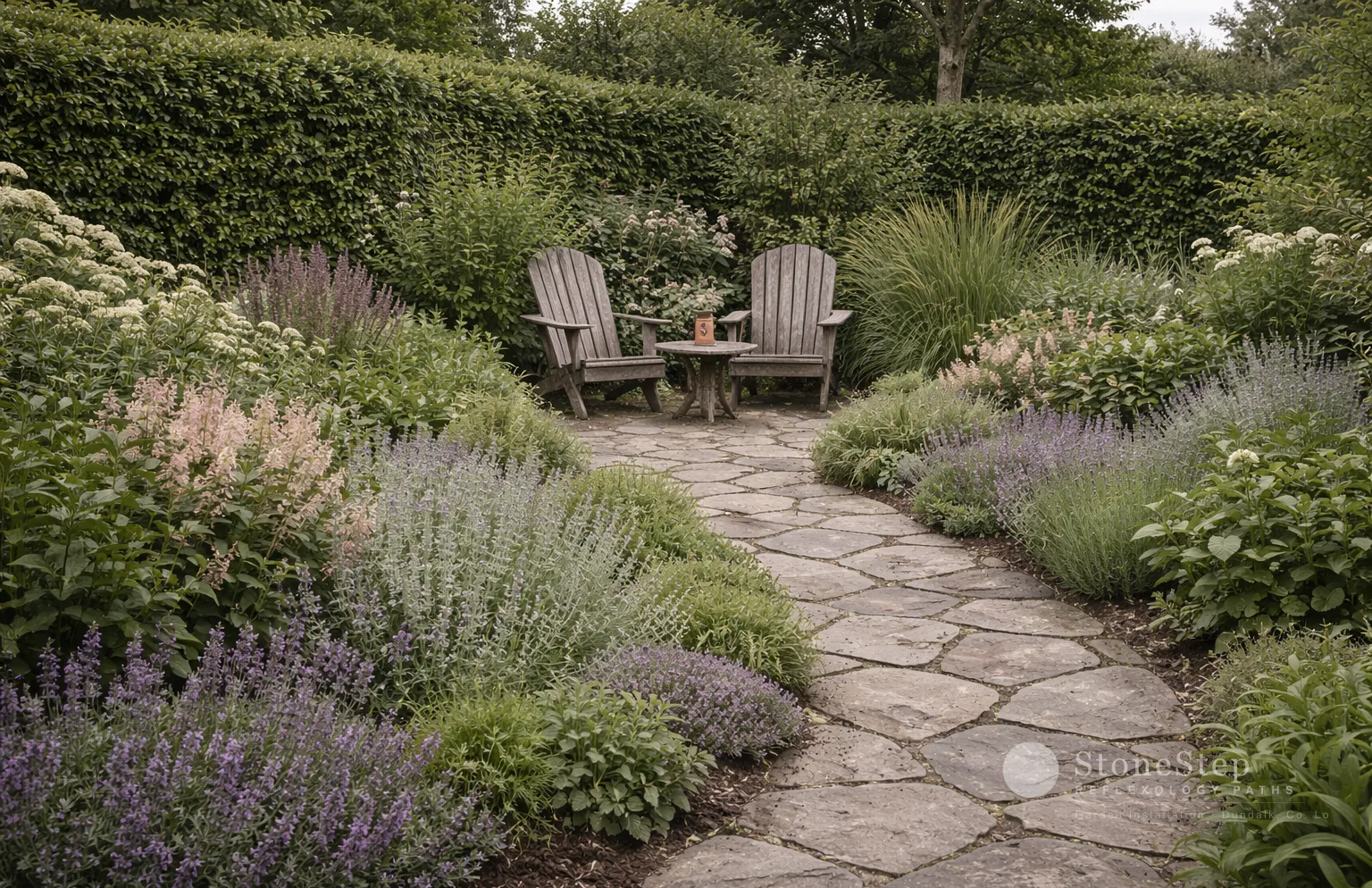
Wellness Gardens in Co. Louth: A Quiet Shift
Something is changing in how northeast Ireland thinks about its gardens.
It is not visible in a single project or a sharp trend. It is quieter than that. It shows up in the conversations we have on site visits, in the questions people ask when they first get in touch, in what they describe wanting from the space once it is finished. The language is different from five years ago.
People are not asking for a patio to entertain on. They are asking for somewhere to go when the day has been difficult. They are asking for a path they can walk before work. They are asking for a garden that restores them rather than one that impresses their neighbours.
This post looks at what is behind that shift in Co. Louth, what it looks like in practice in northeast Irish gardens, and where it seems to be going.
What Changed
Several things converged to produce this shift, and it is worth naming them.
The period from 2020 onward changed the relationship between Irish households and their outdoor spaces in a way that has not fully reversed. People who had previously used their gardens occasionally discovered that they could be used daily, and that daily use over months produces a relationship with an outdoor space that occasional use does not. The garden became, for a period, the only outdoor space reliably accessible. Many people found that it was enough.
What followed that period was a more intentional relationship with the garden. Having discovered what the space could provide, people became more deliberate about what they wanted it to provide, and less satisfied with a space that was merely functional or presentable.
At the same time, something broader was shifting in how Irish people relate to health and wellbeing. The language of restoration, of slow movement, of practices that accumulate rather than deliver a single dramatic result, has become more familiar and more credible. Walking is a serious health practice. Being in nature is genuinely beneficial. Spending time in a considered outdoor space, in the right conditions, changes how you feel at the end of the day.
These ideas are not new. What is new is how widely they are now held.
What It Looks Like in Co. Louth
A wellness garden in Co. Louth is not an imported concept. It is not a Japanese garden dropped into a Dundalk housing estate, or a Scandinavian spa feature installed in a Drogheda back garden. The best versions we encounter are gardens that read as deeply Irish while being deliberately restorative.
They tend to share certain qualities.
A reason to be outside. Not a reason to look at from the window, but a reason to put your shoes on and go out. A reflexology path that rewards barefoot walking. A bench positioned to catch the limited winter sun at two in the afternoon. A fragrant border at the back gate that you brush past on your way to work. These are modest interventions, but they change behaviour.
Materials that belong. Natural stone from the region, or materials in sympathy with the local palette: the grey-green limestone of the Cooley Peninsula, the warm sandstone tones that complement Dundalk’s red brick. A garden that looks as though it grew from its specific place has a quality that a designed space assembled from a catalogue cannot replicate.
Sound. Northeast Ireland is not a quiet place by European standards. The M1 is close to many Co. Louth gardens. A small water feature, even a very simple one, changes the acoustic quality of a garden significantly. It does not mask the road, exactly. It provides an alternative foreground. The ear shifts its attention.
Space for stillness. Most Co. Louth gardens do not have large footprints. But even in a 50 square metre back garden, there is usually room for a seating position that is enclosed on two or three sides, oriented toward the quieter part of the garden, and positioned so that the view from it is of planting rather than fence or wall. A small thing, done deliberately.
The Reflexology Path in a Local Context
The reflexology garden path is the installation most specific to the wellness garden concept, and it deserves particular mention in a Co. Louth context.
There are no reflexology garden paths in public parks in northeast Ireland at the time of writing. The practice that has been a feature of public space in South Korea, Taiwan, and Singapore for generations, and is increasingly found in private gardens across Britain and Europe, remains rare here.
That means that a residential reflexology path in Co. Louth is a genuinely distinctive feature. It is not something the next garden also has. It is specific to the household that commissions it, to the people who use it, and to the garden it is built into.
We have found, in conversations with clients who have commissioned reflexology paths, that the distinctiveness is part of what they value. Not as a status feature, which would be exactly the wrong spirit for this kind of installation, but as a commitment to a practice that is theirs alone. The path is built for how they want to live. Nobody else in the neighbourhood has one.
What the Shift Means for Garden Design
The move toward wellness-oriented garden design is producing a different kind of brief.
Where a garden project ten years ago might have started with material preferences and a budget, we now find that many clients arrive with a clear sense of how they want the garden to feel and what they want to do in it. The material choices and the budget follow from that sense rather than preceding it.
This is a better starting point. A garden designed around how it will be experienced, rather than around how it will look in a photograph, tends to produce something that performs for the people who live with it rather than performing for people who visit once.
The wellness garden trend in Co. Louth and across Leinster is not a passing fashion. It is a response to something real: the discovery that a garden, used well and designed with intention, is one of the most effective and most underused resources for daily restoration that most households already own.
See our wellness garden design guide for a full account of the elements that make a restorative garden in an Irish setting, and our reflexology garden paths service for what a path installation involves.
Request a free design consultation →
Frequently Asked Questions
Is a wellness garden appropriate for a small Co. Louth garden? Yes. A wellness garden is defined by intention rather than size. The elements, considered planting, a water feature, a seating position with enclosure, a stone path with character, scale to almost any footprint. A thoughtfully designed 30 square metre garden can be more restorative than a large, unfocused one.
Do I need a specialist garden designer for a wellness garden? For the hard-landscaping elements, StoneStep handles the path, paving, and stone work. For planting design, a planting specialist adds significant value, particularly for fragrant and textural plant selection suited to Co. Louth’s climate. We can recommend planting designers we work alongside.
Are reflexology garden paths increasingly common in Ireland? They remain rare in Irish private gardens at present, which means a Co. Louth installation is genuinely distinctive. Interest is growing, and we are receiving more enquiries than in previous years. We expect this to become a more familiar feature of Irish wellness gardens over the next five to ten years.
What is the best season to begin planning a wellness garden in Co. Louth? Autumn and winter are the best time to plan, with installation in early spring. Planting decisions benefit from understanding how the garden receives light and drainage across the seasons. Hard-landscaping work can begin from March onward, and having the bones of the garden in place before the growing season means the planting can establish through summer.
Have a question about your garden?