
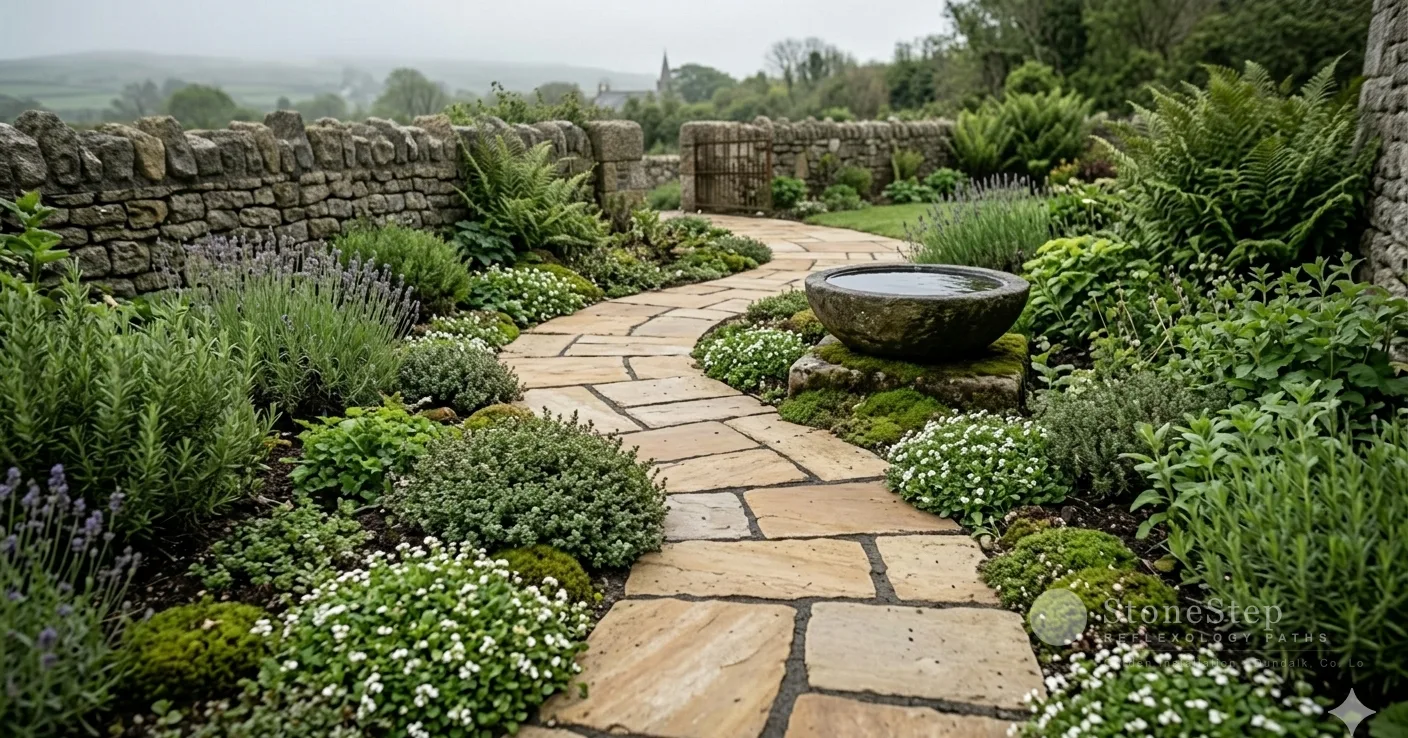
What Goes Into a Wellness Garden in Ireland
A wellness garden is not a style. It is not a mood board or a set of materials. It is a considered approach to what a garden is for, and what it can do for the people who use it.
The question at the centre of it is straightforward: can this garden restore the person who spends time in it? Not entertain, not impress, not demonstrate horticultural knowledge. Restore.
In Co. Louth, that question has a specific Irish inflection. The climate is wet and the light is soft. The growing season is long but the outdoor season is complicated by persistent rain and cold. A wellness garden here needs to work across the seasons, offer genuine reward for being outside in imperfect conditions, and feel grounded in the landscape rather than imported from elsewhere.
This post works through the elements we bring together when designing a wellness garden in northeast Ireland: what each one contributes, and how they relate to each other.
The Path
The path is not just access. In a wellness garden, it is the primary means by which the garden is experienced.
A path with intention draws you through the space in a particular sequence, revealing different aspects of the garden as you move. It creates a reason to be present, rather than simply passing through. A straight path from the door to the back wall is functional. A path that curves, pauses, and moves through planting has a different quality: it invites a slower pace.
In a wellness garden, the path surface also matters. Natural stone, with its varied texture and its responsiveness to light and season, contributes to the character of the space in a way that poured concrete or uniform paving does not. A reflexology path section, where rounded pebbles replace flat stone for a few metres, turns the walk into a physical practice. Taking your shoes off, moving slowly, paying attention to what is underfoot: these are the conditions in which a garden begins to do its work.
See our reflexology garden paths service for what that specific installation involves.
Fragrant Planting
The most underused element in most Irish gardens, and perhaps the most directly powerful.
Smell bypasses the conscious mind in a way that visual stimulation does not. The fragrance of lavender, of thyme bruised underfoot, of evening primrose opening at dusk, or of a rose in the brief period of June when a Co. Louth garden can be warm enough for it, reaches a part of the nervous system that deliberate relaxation techniques struggle to access.
Planting for fragrance in an Irish wellness garden requires some realism. Many Mediterranean aromatics, lavender, rosemary, sage, will grow here but need a well-drained, south-facing position to thrive as they would in their native climate. In shadier or wetter parts of a Louth garden, native and near-native plants perform better: sweet cicely, with its mild anise scent, holds moisture well. Honeysuckle is at its most powerfully fragrant in the cool of an Irish evening. Elder flower in June is fleeting but worth planting for.
Positioning matters as much as selection. Fragrant plants placed along the path edge, so that you brush them as you walk, work differently from the same plants in a bed you observe from a distance. The intention is contact, not viewing.
Water
The sound of water in a garden does something specific. It masks the environmental noise of daily life, the traffic and background hum that the mind is perpetually processing, and replaces it with something that the nervous system receives differently.
In a wellness garden, the water feature does not need to be large or dramatic. A small rill of moving water, a stone bowl with a slow overflow, a wall-mounted spout onto a cobble bed: any of these introduces the quality of moving water sound without dominating the space. The goal is auditory foreground, not spectacle.
Water also introduces movement and light into a garden that is otherwise static. The surface of still water reflects sky and changes with cloud. Moving water catches light in ways that no planted surface does. For a garden that needs to function across the grey months of an Irish autumn and winter, these qualities of movement and reflection matter more than they do in summer.
Stone
Natural stone in a wellness garden serves multiple purposes beyond hard-landscaping.
Stone retains heat and releases it slowly, creating a microclimate at ground level that extends the comfortable period for barefoot walking or sitting outside. A south-facing stone wall behind a seating area raises the air temperature noticeably and changes the experience of being in that part of the garden.
Stone as a material carries a quality of permanence and weight that planting does not. In a garden designed for restoration, that permanence has a particular value. The stone was there before you and will be there after. That is not a poetic abstraction; it is a physical fact that registers at a sensory level.
Natural stone paths, paving, and seating surfaces are the bones of a wellness garden. They determine the structure, the movement, and the relationship between different parts of the space. The planting grows and changes around them. The stone holds.
Shelter and Enclosure
An exposed garden is difficult to be still in. Co. Louth’s northeast position means prevailing winds from the north and east are persistent in autumn and winter. A wellness garden needs at least one sheltered space where it is possible to sit outside on a day that is cold but not wet, which in northeast Ireland describes a significant proportion of the year.
Shelter can come from existing walls, mature hedging, or deliberately planted wind-filtering screens. A dense native hedge of hawthorn and blackthorn, established over four or five years, will reduce wind speed substantially on its leeward side and provide habitat for birds and insects that add sound and movement to the garden.
Enclosure is slightly different from shelter. A sheltered garden blocks wind. An enclosed garden creates a sense of containment and privacy that affects how the space feels to be in. Even a partially enclosed space, defined on two or three sides by planting or low stone walls, creates a quality of being held that changes the experience of sitting in it.
In Japanese garden design, the relationship between enclosure and prospect, being contained while having a view outward, is a core design principle. It translates directly to the Co. Louth context: a seating area backed by dense planting, opening toward a longer view of the garden or the landscape beyond, provides both security and openness simultaneously.
Seating
A wellness garden without seating is a garden you pass through rather than inhabit.
The placement of seating matters as much as the seating itself. A bench in the sun at the south-facing end of the garden, used in winter for twenty minutes of light-exposed sitting, is a different thing from a chair in the middle of an open lawn. The garden should offer somewhere to be rather than somewhere to look at.
Natural stone seating, a flat-topped boulder, a low stone wall with a comfortable depth, integrates with the garden in a way that a wooden bench does not. It is part of the material continuity of the space. It weathers alongside the rest of the garden. And in warm weather, stone that has been sitting in sun holds that warmth when you sit on it.
How the Elements Work Together
Each element of a wellness garden contributes something, but the quality of the space is created by how those elements relate to each other.
The path draws you in and sets the pace. The fragrant planting at the path edge rewards the slow walking the path invites. The water feature provides auditory softening for the space you arrive at. The stone surfaces hold warmth and give permanence. The shelter makes it possible to be there comfortably. The seating gives you a reason to stop.
None of these elements is dramatic. A wellness garden does not announce itself. It offers a quality of experience that accumulates over the time you spend in it, and improves over the years you live with it.
That accumulation over time is the particular value of designing a garden with this intention from the outset, rather than arriving at it piecemeal. The path is laid to work with the planting. The planting is chosen to work with the stone. The shelter is positioned to make the water feature audible from the seating. These are design decisions, not afterthoughts.
At StoneStep, we design and build the hard-landscaping elements of wellness gardens across Co. Louth: the path, the paving, the stone seating, and the reflexology path where that is part of the brief. We work alongside planting specialists where the full garden design requires it.
Request a free design consultation →
Frequently Asked Questions
How large does a garden need to be for a wellness garden? There is no minimum size. The elements can be scaled to almost any garden footprint. A small courtyard of 20 square metres can have a meaningful stone surface, a fragrant climber, a small water feature, and a simple seating position. The key is intention in the design rather than scale.
How long does a wellness garden take to establish? The hard-landscaping elements are complete immediately. Planting takes two to three seasons to begin performing as designed. A dense shelter hedge takes four to five years to reach a useful height. A wellness garden is a medium-term investment; the experience at year five is substantially richer than at year one.
Does a wellness garden require specialist maintenance? No more than any other garden. Natural stone surfaces need annual cleaning and periodic sealing. Fragrant planting benefits from regular cutting back to keep it producing fresh growth. A water feature needs seasonal attention to keep it clear. None of these requires specialist skill, only regular attention.
Can a wellness garden work in a north-facing plot? Yes, with adjusted plant selection and design. A north-facing garden in Co. Louth will not support a Mediterranean herb bed, but it can support ferns, hostas, shade-fragrant plants like lily of the valley and sweet woodruff, a small rill of moving water, and a reflexology path that remains usable across the year. The design emphasis shifts toward texture, sound, and movement rather than sun and warmth.
Have a question about your garden?