
From First Call to Finished Path: What to Expect
Before a project begins, it helps to know what the process actually feels like. Not just the stages, which are covered in our installation guide, but the sequence of events from your first enquiry through to the morning you walk the finished path for the first time.
This post is a clear account of that experience, in the order it unfolds. It covers what happens when, what you need to do, and what you do not need to do. It also covers the realistic timescales involved, from first contact to completion, for a standard garden path installation in Co. Louth.
Week Zero: Making Contact
You get in touch. By phone, by the contact form, or by email. You tell us where you are, what you are thinking, and roughly what the project involves.
At this stage, you do not need to know which stone you want, how wide the path should be, or exactly how it should run. Those are questions we work through together on site. What is useful to have a sense of, even loosely, is: what is the path for (front approach, back garden, side access, something else), roughly how long it is, and whether the ground has any obvious complications, such as a significant gradient or poor drainage.
We will come back to you within one working day to arrange the site visit.
Week One: The Site Visit
The site visit is free and carries no obligation.
We come to the garden, look at the ground conditions, and discuss the project with you. This typically takes 45 minutes to an hour. During that time we cover:
What the path needs to do, and how it will be used. Stone options, with honest guidance on which suits the garden and the property. The drainage picture: how water moves across the garden and what the path preparation needs to account for. Any complications, roots, services, difficult access, significant gradient. An approximate sense of the cost, before the written quote follows.
You are not committed to anything at this point, and we do not expect a decision on the day.
The site visit is the most useful part of the whole process for both sides. We get the information we need to give you an accurate quote. You get a realistic picture of what is involved and what it will cost, from someone who has looked at your specific ground.
Week One to Two: The Written Quote
We provide a written, itemised quote within 48 hours of the site visit.
The quote breaks down materials (stone supply, sub-base aggregate, mortar, jointing compound), ground preparation and excavation, stone laying and cutting, jointing, and any site-specific items such as drainage work or the removal of an existing surface.
If anything in the quote is unclear, call or email and we will go through it. We would rather you understand exactly what you are agreeing to than have any ambiguity at this stage.
You can take as long as you need to make a decision. We do not apply pressure, and the quote remains valid for 30 days.
Booking and Scheduling
When you confirm that you would like to proceed, we book the job into the schedule.
Demand in Co. Louth for stone path and patio installation follows a predictable seasonal pattern. The busiest period runs from March through September. If you want work completed in spring or early summer, booking in late winter is advisable. Autumn slots are often more flexible.
We will confirm a start date that works for both sides. For most residential paths, the lead time from booking to start date is two to four weeks during peak season, and shorter in autumn and winter.
The Week Before: Preparation
In the week before the start date, we will confirm the schedule with you and clarify any access requirements.
Most garden path installations require: a clear access route to the work area, ideally wide enough for a wheelbarrow; somewhere nearby to temporarily stack excavated material before it is removed; and a water supply available on site (we use a garden hose for mixing and for damp-curing the mortar).
We do not need you to clear the garden, move furniture, or make any structural changes. We ask that planting immediately adjacent to the path line is protected where possible, but we work carefully around established planting and will flag anything we think might be at risk before we start.
On Site: Day One
The first day is excavation and sub-base.
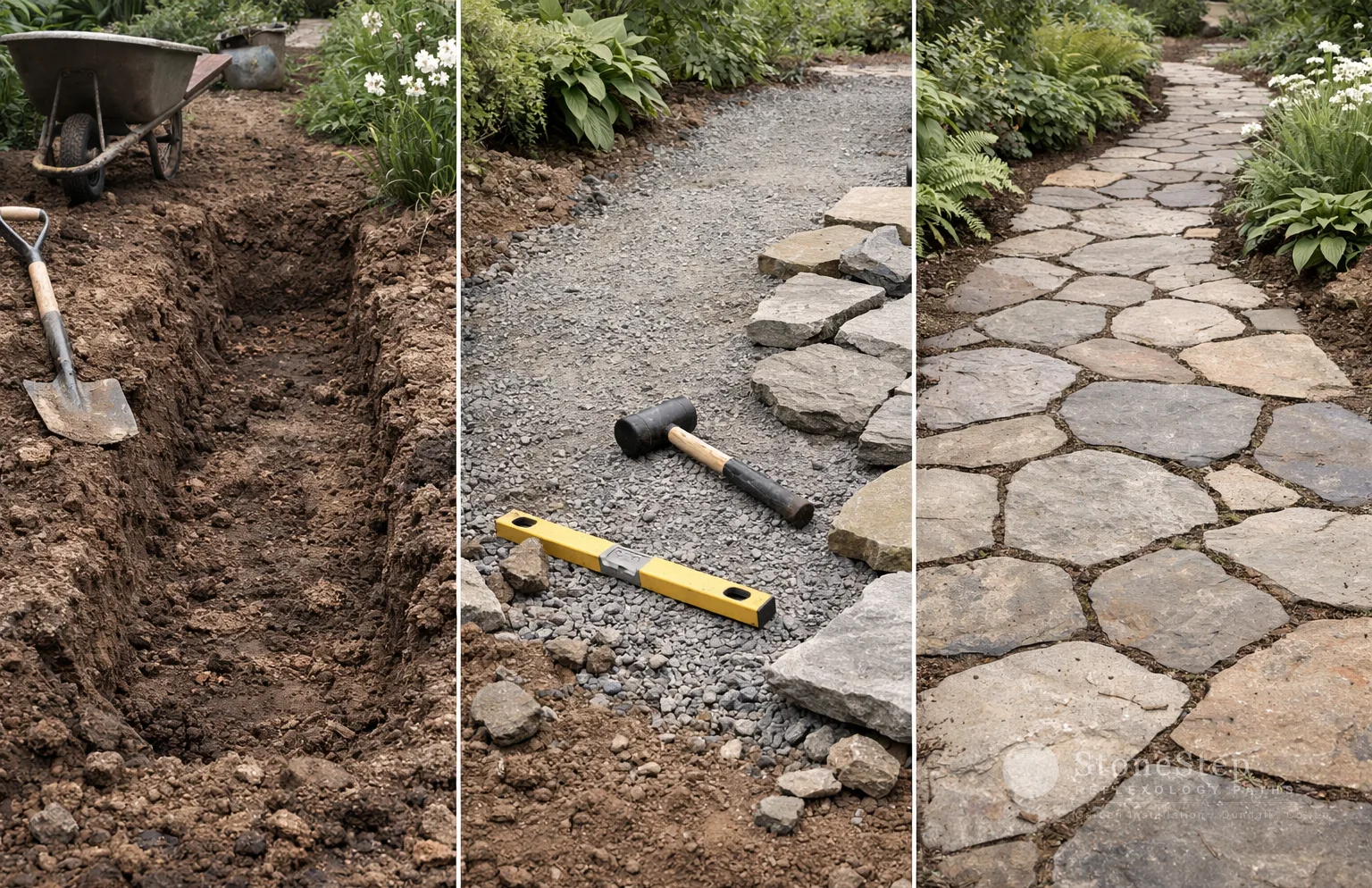
We mark out the path line, set the edge restraints, and begin excavation. The ground is dug to the required depth (typically 150 to 200mm below the proposed finished surface level) and all topsoil is removed. The excavated material is loaded for removal.
The sub-base aggregate is then laid and compacted in passes using a vibrating plate compactor, building up to a minimum compacted depth of 100mm. We check level and fall throughout, building the drainage fall into the sub-base so it carries through to the finished surface.
At the end of day one, the ground looks like a prepared trench. This is the least photogenic stage of the installation and the most important one.
On Site: Day Two
The bedding layer goes in and stone laying begins.
The semi-dry mortar bed is spread and screeded to the correct level, accounting for the thickness of the stone being used. Stone laying starts from a fixed reference point and works outward. Each slab is placed, checked, adjusted, and set. Cuts are made as they are needed using a wet-cutting disc saw.
For a standard 10 to 15 metre garden path, most of the stone laying is completed on day two. Larger paths, or paths with complex curves or multiple changes of level, may run into a third day.
On Site: Day Three (or End of Day Two)
Once the mortar bed has cured for 24 to 48 hours, the joints are filled.
We use polymeric jointing compound for most residential path installations. The compound is brushed into the joints, compacted, cleaned from the stone faces, and activated with water. It cures to a firm finish and resists weed germination.
The site is cleaned. Waste material and any remaining excavated soil are removed. The path is swept.
The Curing Period
The path needs 48 to 72 hours before light foot traffic. During this time the mortar bed is completing its initial cure and the jointing compound is setting.
We ask that nothing is placed on or dragged across the surface during this period. After 48 to 72 hours, the path can be walked normally. After five to seven days, it can bear furniture, loading, and normal garden use.
The First Winter
Most natural stone paths settle comfortably through their first winter without any intervention. The jointing compound occasionally settles slightly in the first freeze-thaw cycle and leaves small gaps at the joint surface. This is normal and not a structural issue.
If you notice any joints that have partially opened after the first winter, a ten-minute brush-in of dry polymeric jointing sand, followed by light wetting, resolves it. We will mention this at handover.
If anything concerns you in the first year, contact us. We stand behind our work and will come out to look at anything that needs attention.
From First Call to Finished Path: The Full Timeline
For a standard residential garden path in Co. Louth:
- First contact to site visit: within 1 week
- Site visit to written quote: 48 hours
- Quote acceptance to start date: 2 to 4 weeks (peak season); shorter in autumn/winter
- On site duration: 2 to 3 days
- Curing before light use: 48 to 72 hours
- Ready for full use: 5 to 7 days after completion
Total elapsed time from first enquiry to a fully usable path: typically 4 to 6 weeks during the main season.
For projects combining a path and a patio, or for larger or more complex installations, the on-site duration extends accordingly. We provide a specific timeline in the written quote for every project.
Frequently Asked Questions
Do I need to be present on site during the installation? Not necessarily. We work independently once access is confirmed. Some clients prefer to be around on day one when the path line is being marked, to confirm the alignment before excavation begins. After that, most projects proceed without the client needing to be present.
What happens if it rains during the installation? Excavation and sub-base work can proceed in most rain. We do not lay mortar in heavy rain, as this dilutes the mix, or in temperatures below 3°C overnight. If a rain day means pausing the mortar work, we will add a day to the schedule. We will keep you informed.
Can the path line be adjusted after the site visit but before work begins? Yes, minor adjustments are usually possible. If the change significantly affects the scope of work or the materials needed, we will update the quote accordingly and confirm before proceeding.
What if I want to extend the path or add paving later? This is straightforward to accommodate. The sub-base and drainage for the existing path are designed to accommodate a reasonable extension without needing to redo the foundational work. We can advise on this if you have future plans in mind at the time of the original quote.
Have a question about your garden?