
Reflexology Path or Sensory Garden: The Difference
Both terms come up when people begin thinking seriously about a garden that does more than look well. Reflexology path. Sensory garden. They are used sometimes interchangeably, sometimes as if one is a component of the other, and sometimes as alternatives to consider.
They are different things with different intentions, though they can and often do exist together. This post sets out what each is, how they differ, and how to decide which one your garden calls for.
What a Reflexology Path Is
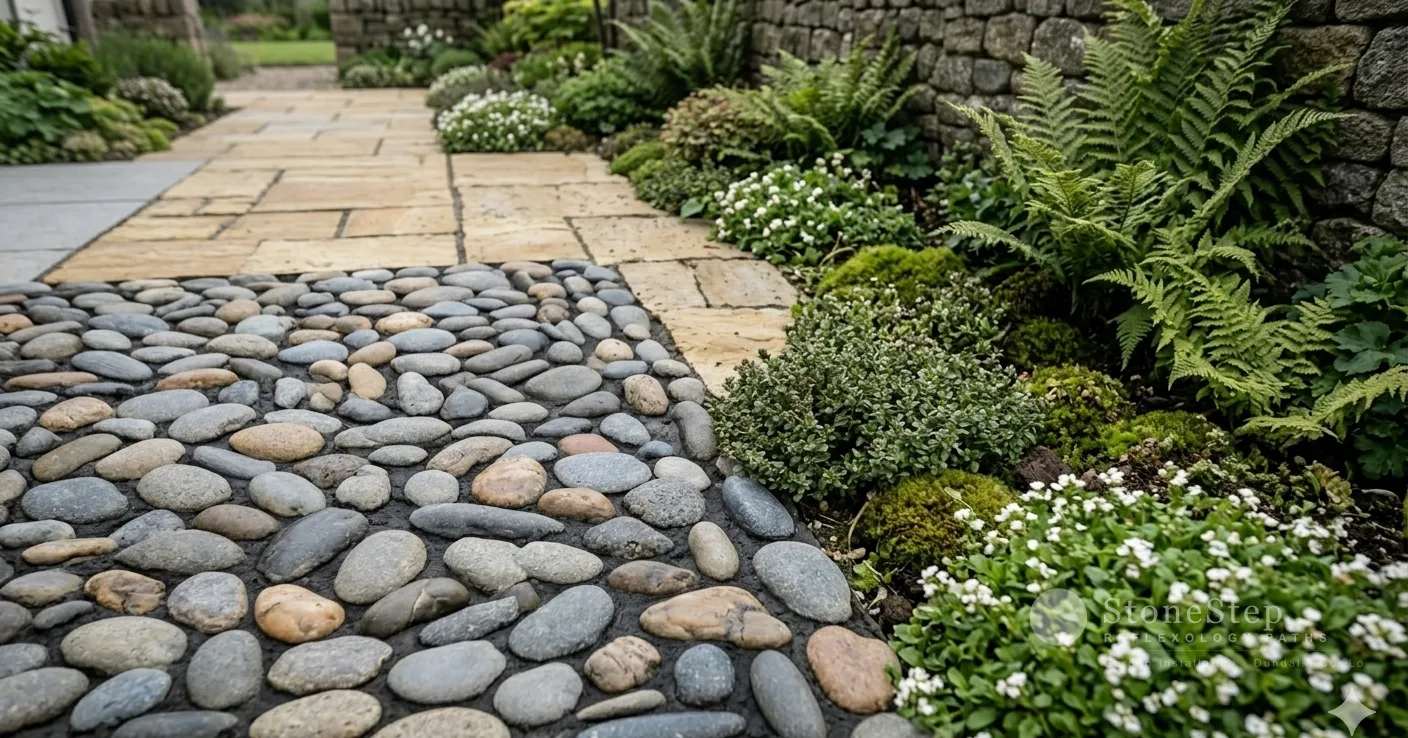
A reflexology path is a specific, intentional installation: a walking surface built from rounded natural stones and pebbles, laid in a mortar bed, designed to be walked barefoot. The surface variation stimulates the pressure points on the soles of the feet as you move across it, engaging the foot’s dense network of nerve endings in a sustained, graduated way.
The experience is primarily underfoot. You may be aware of the garden around you, and that awareness is part of what makes the practice restorative, but the active element of what a reflexology path does happens between the sole of your foot and the stone surface beneath it.
A reflexology path is a daily practice made physical in the garden. It is used, not admired. It works best when walked slowly, without shoes, for five to ten minutes at a time. See our guide to how reflexology paths work for a full explanation of the mechanism.
What a Sensory Garden Is
A sensory garden is broader in scope and less defined in form. It is a garden, or a section of a garden, designed to engage multiple senses simultaneously: sight, smell, touch, sound, and sometimes taste. It is a designed experience of a space rather than a specific activity within it.
A well-designed sensory garden in an Irish context might include:
Planting chosen for fragrance at different heights and across different seasons. Plants whose leaves have varied textures, from the soft of lamb’s ear to the rough of sage, that reward being touched. A water feature whose sound is present without being dominant. Surfaces that invite you to remove your shoes. Paths that draw you through the space in a particular sequence. Seating that orients you toward something worth sitting and looking at.
The experience of a sensory garden is atmospheric. You arrive into it and it works on you gradually, through the accumulation of sensory detail. You do not need to do anything specific to receive what it offers.
How They Differ
The clearest way to state the difference is this:
A reflexology path asks something specific of the body. A sensory garden asks something of the whole person.
A reflexology path is an active, focused practice. It works through physical engagement with a particular surface. The benefits come from what happens when you use it correctly: slow, attentive, barefoot walking.
A sensory garden is a passive, ambient experience. It works by offering a rich enough environment that the nervous system downregulates in response. You do not need to do anything specific. The experience happens to you as you move through the space or simply sit in it.
Both are responses to the same underlying need, the need that many people feel for a garden that restores rather than merely displays. But they meet that need through different means.
The Case for a Reflexology Path
A reflexology path is the right choice when the intended use is a defined daily practice: a specific number of minutes, bare feet, attentive walking, repeated regularly. If you are drawn to the tradition of stone-path walking, to the Eastern understanding of the foot as a map of the body, or simply to the idea of a focused physical practice that lives in your own garden, a reflexology path is the more intentional installation.
It is also a more permanent and considered commitment than general sensory planting. Building a reflexology path properly, with a sound sub-base and carefully selected and set stone, is skilled work that produces a specific, functional result. It is an installation rather than a planted feature.
For households where one or more people have a specific interest in the practice, where the garden has the space for a path of meaningful length (six metres or more), and where the daily use is genuinely anticipated, a reflexology path delivers something that no arrangement of planting can replicate.
The Case for a Sensory Garden
A sensory garden is the right choice when the intention is broader: a garden that feels different from a conventional one, that rewards time in it, that provides a quality of rest rather than a specific practice.
It is more flexible in terms of space and form. A small courtyard can be a sensory garden. A single planted bed alongside a path can contribute sensory experience without requiring a dedicated installation. The component elements, fragrant planting, textured foliage, water sound, varied surface materials, can be added gradually.
A sensory garden is also more naturally inclusive across ages and abilities. It can be experienced from a wheelchair. It engages children through curiosity rather than instruction. It does not require removing your shoes or committing to a practice. You enter it and it meets you where you are.
Why the Two Often Go Together
A reflexology path within a sensory garden is one of the most satisfying combinations in a wellness-oriented Irish garden. The path provides the focused, physical practice; the wider planting and water elements provide the atmospheric quality of the space the path moves through.
Walking a reflexology path slowly, with fragrant thyme or chamomile planted at the path edge, with the sound of a small water feature nearby, and with the wider garden in peripheral view, is a qualitatively different experience from walking the same path in a bare, functional space.
The reflexology path becomes more useful because the garden it sits within is more restorative. The sensory garden benefits from having a specific, intentional practice at its centre, something that gives the visitor a reason to be present in a particular way.
At StoneStep, we approach wellness garden design with this relationship in mind. The reflexology path is rarely the whole garden; it is usually the spine of something larger.
Which One Is Right for Your Garden
A few questions worth sitting with before deciding:
Is there a specific practice you intend to build into daily life, or are you looking for a garden that feels different to be in?
Is the space large enough for a reflexology path of meaningful length, or does it suit a more distributed sensory experience?
Who will use the garden, and how? One person with a specific interest in reflexology, a family, older adults, young children?
Both elements, or either one alone, can be designed into a Co. Louth garden of almost any size. We discuss this in detail on site visits, where we can look at the actual space and talk through what fits the garden, the household, and what you are trying to create.
See our reflexology garden paths service for what a path installation involves, and our wellness garden design guide for a broader view of the elements that make a restorative garden in an Irish setting.
Request a free design consultation →
Frequently Asked Questions
Can a reflexology path be added to an existing sensory garden? Yes, and this is one of the more common briefs we receive. If the space already has planting, seating, and a general sensory character, adding a properly built reflexology path gives the garden a specific, functional core it may currently lack.
Is a sensory garden accessible to people with physical disabilities? Sensory gardens are among the most naturally inclusive garden types. Raised beds bring planting within reach of wheelchair users. Fragrant and textural planting rewards proximity without requiring mobility. Smooth, even paths allow access for those who cannot manage uneven surfaces. A reflexology path requires barefoot walking on a textured surface, which is not appropriate for everyone; the sensory garden around it can be designed for full accessibility.
Can children use a reflexology path? Yes. Children find the varied stone textures naturally engaging. A properly built reflexology path with smooth, rounded stones and no sharp edges is safe for children. The sensory garden elements around it, varied planting, water, different surface materials, are likely to engage them as much as the path itself.
How much garden space does each require? A meaningful reflexology path needs a minimum of about six metres in length and 800mm in width, plus a surrounding border for planting if desired. A total footprint of eight to twelve square metres is typical for a residential installation. A sensory garden can be created in almost any size of space; the elements can be scaled to what is available.
Have a question about your garden?