
Could a Reflexology Garden Path Benefit Your Health?
The idea of a garden path built specifically to be walked barefoot is one that tends to stop people. Not in a sceptical way, exactly. More in the way of something they had not considered before but which, once heard, makes an immediate kind of sense.
This post looks at what a reflexology garden path actually involves, what the evidence says about walking on one regularly, and how to think about it as a daily health practice rather than a garden feature.
What Reflexology Path Walking Is
Reflexology as a formal therapy involves applying targeted pressure to specific points on the feet, hands, or ears, on the understanding that these points correspond to organs and systems throughout the body. A reflexology garden path takes that principle and builds it into the ground itself.
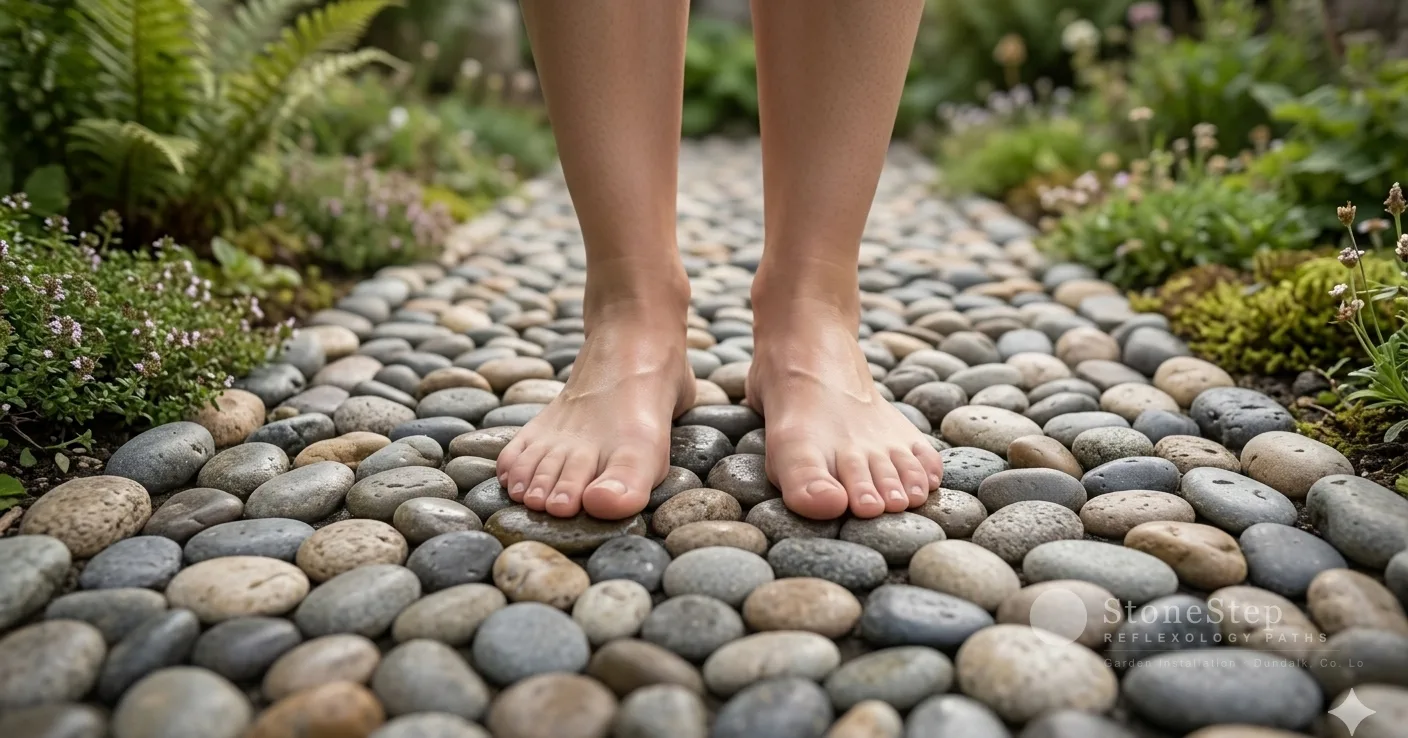
The path surface is made from smooth rounded natural stones and river pebbles, laid in a considered arrangement that varies in texture, size, and density along the path length. Walking barefoot across this surface stimulates the pressure points on the soles of the feet continuously and in a graduated way, as the different stone zones engage different parts of the foot.
The practice has deep roots in East Asian tradition. Stone-stepped paths have been used for therapeutic walking in Taiwan, Japan, and South Korea for generations, often as a daily morning practice. In many Taiwanese villages, communal pebble paths were built specifically for this purpose. In South Korea, reflexology paths are a standard feature of public parks. The concept is not new; what is new is its slow arrival into Western private gardens.
What the Research Actually Says
The evidence for the benefits of regular reflexology path walking is more solid than it might first appear.
A study published by the Oregon Research Institute tested the effects of regular cobblestone mat walking on older adults over a sixteen-week period. Compared to a control group walking on standard surfaces, the cobblestone walkers showed meaningful improvements in a range of measures: reduced blood pressure, better balance, lower perceived pain, and improved self-reported mental wellbeing. The differences were statistically significant and persisted after the trial ended.
The biological mechanism is relatively straightforward. The soles of the feet contain a dense concentration of nerve endings, proprioceptors, and pressure receptors, among the highest density of any surface area on the body. Regular stimulation of these receptors through varied textured surfaces activates the nervous system in ways that sustained walking on smooth, flat surfaces does not. It improves the quality of sensory feedback from the feet, which has downstream effects on balance, posture, and the overall calibration of the nervous system.
There is also a growing body of research on barefoot walking more broadly, sometimes called earthing or grounding, and it suggests that direct contact between the bare foot and natural surfaces has measurable physiological effects including reduced cortisol levels and improved sleep quality. A reflexology path, walked barefoot in a garden, combines the specific pressure stimulation of stone-path walking with those broader benefits of bare-foot contact with the ground.
What Regular Use Actually Feels Like
The benefits of a reflexology path are not dramatic or immediate in the way a treatment session might be. They are cumulative.
Five to ten minutes walked daily, without shoes, at a pace that allows attention to what is underfoot. That is the practice. The first few sessions tend to feel quite intense, particularly under the arch of the foot and the heel, where many people carry habitual tension without being aware of it. As the feet become accustomed to the surface, the sensation shifts from stimulation to something closer to massage.
People who use a reflexology path regularly tend to describe the effect in similar terms. A quality of mental quiet that follows the walk. A sense of having properly connected with the ground after a day spent in shoes on hard floors. Reduced tension across the lower back and legs. Better sleep, particularly when the walk is taken in the evening.
None of these outcomes are guaranteed. But they are consistently reported, and they align with what the research on sensory foot stimulation would predict.
Who Benefits Most
A reflexology path is a genuinely inclusive feature. The benefits vary, but they exist across a wide age range:
For people who spend most of their day indoors. The combination of barefoot sensory contact, natural materials, and time outside has a grounding effect that is disproportionate to the ten minutes it takes.
For older adults. Balance improvement is the most clearly evidenced benefit in research involving older age groups. The proprioceptive stimulation from varied underfoot texture recalibrates the sensory feedback system that governs stability. For older family members, a wider path with a handrail is worth considering.
For anyone carrying chronic low-level stress. The focused sensory attention that barefoot stone-path walking requires is, in effect, a form of moving meditation. It is difficult to be elsewhere mentally while paying attention to what you can feel underfoot.
For children. Young feet are highly receptive. Children find reflexology paths engaging rather than therapeutic, but the sensory experience of varied textures is valuable at any age and particularly during development.
A Daily Practice That Lives in the Garden
What makes a reflexology path different from a treatment, a class, or a wellness programme is that it requires no booking, no travel, and no effort beyond stepping outside.
The path is there each morning. The practice is as simple as taking your shoes off and walking it slowly.
That accessibility is most of the value. A reflexology treatment provides an hour of concentrated stimulation, perhaps once a month. A reflexology garden path provides ten minutes daily, which over a month represents substantially more cumulative input, at no additional effort.
The Japanese concept of kaizen, meaning small, consistent improvements that compound over time. That framing describes this well. The benefit of a reflexology path is not dramatic. It is the quiet accumulation of ten minutes, most mornings, for years.
Building One in Your Garden
A reflexology path is a permanent garden installation, built from natural stone and rounded river pebbles set in a mortar bed. It requires proper ground preparation, considered stone selection, and careful hand-setting of every stone. It is not a DIY project done in a weekend, and it is not a product that can be ordered from a catalogue.
StoneStep designs and installs bespoke reflexology paths for gardens, retreats, and hospitality spaces across Co. Louth and Ireland. Every path is specific to the garden and the brief.
For more on the design and installation process, see our reflexology garden paths service. For cost guidance before a site visit, see our reflexology path cost guide.
Request a free design consultation →
Frequently Asked Questions
Do reflexology paths actually work, or is it pseudoscience? The broader claims of reflexology as a clinical treatment remain debated. The specific benefits of regular barefoot walking on textured stone surfaces, including improved balance, reduced blood pressure, better proprioception. These are supported by controlled research. The Oregon Research Institute study is the most widely cited, but it is not the only one. The mechanism is physiological rather than mystical: nerve stimulation through the soles of the feet has measurable effects on the nervous system.
How long does it take to notice a difference? Most people notice a change in how the feet and lower legs feel within two to three weeks of daily use. Improvements in sleep quality and stress levels are typically reported after four to six weeks. Balance improvements, particularly in older adults, may take longer but tend to be more durable.
Is it safe to walk a reflexology path every day? Yes, for most people. Start with shorter sessions of three to five minutes if the surface feels intense initially, and build up gradually. Anyone with diabetes, neuropathy, or any condition affecting sensation in the feet should consult their GP before beginning. The path surface should have no sharp edges; a properly installed reflexology path uses only smooth, rounded stones.
Can a reflexology path be used in all weathers? The surface remains safe to walk in wet weather. In very cold conditions, barefoot outdoor walking requires its own good judgment. The path itself is unaffected by rain or frost when properly built.
Have a question about your garden?