
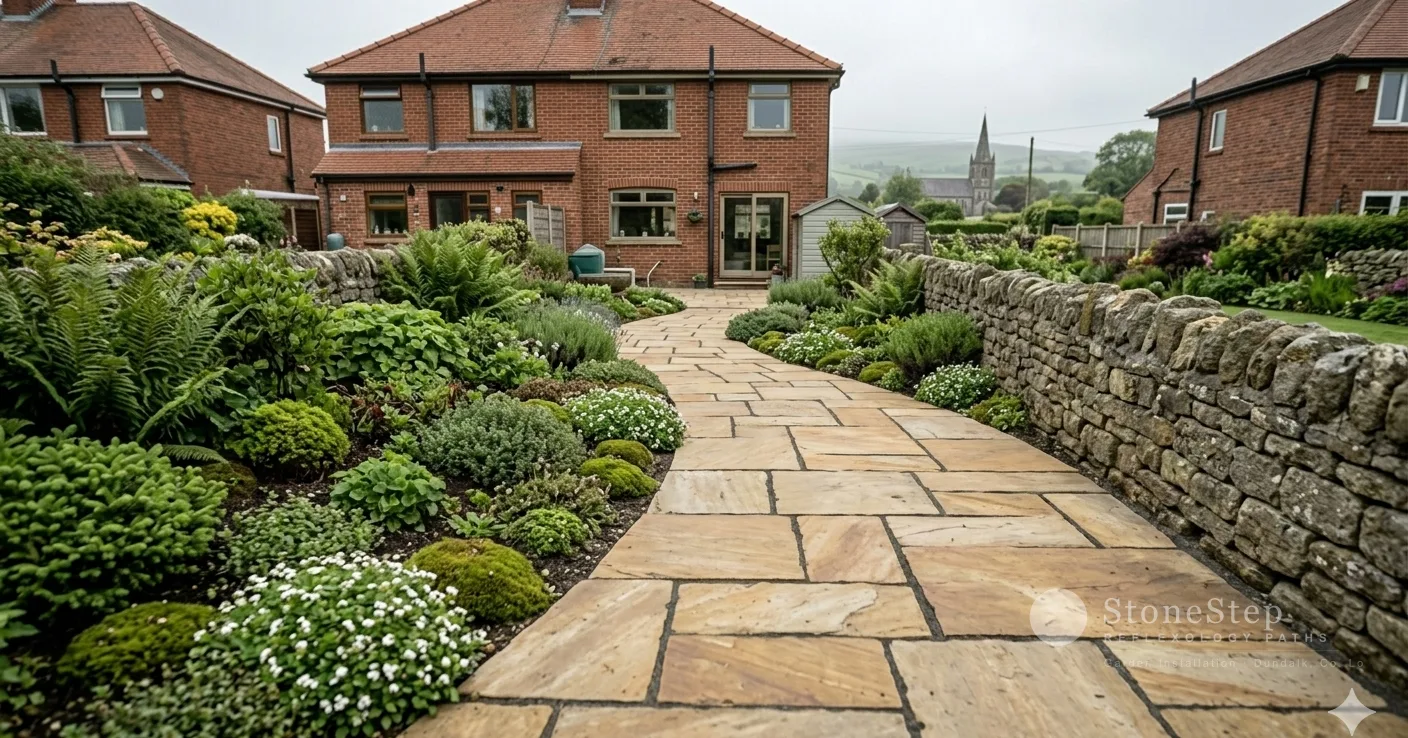
Patio or Path: What Shapes the Cost of Stone Work
Most StoneStep projects in Co. Louth involve either a patio, a garden path, or both together. They are related installations that share the same material and process logic, but they cost differently and for reasons that are worth understanding before you ask for a quote.
This post sets out what drives the cost of each, how the two compare when built in the same stone, and what the cost implications are when a path and patio are commissioned as a single project.
The Shared Cost Components
Before looking at what is different, it is worth being clear about what both types of installation share.
Both a natural stone patio and a natural stone path require the same foundational work: excavation to the appropriate depth, a compacted MOT Type 1 sub-base of adequate thickness, a mortar bedding layer, stone laying, jointing, and any required sealing. These are the non-negotiable elements of any durable natural stone installation in Co. Louth’s clay-heavy ground conditions.
The cost of those elements is not dramatically different per square metre between a patio and a path. The preparation and laying work required per square metre of stone is roughly equivalent regardless of the shape of the surface.
What changes the comparative cost is primarily edge work, cuts, and mobilisation.
Where Paths Cost More Per Square Metre
A garden path is a narrow, linear surface. A patio is a broad rectangular or roughly rectangular area. That difference in geometry produces a meaningful difference in cost per square metre.
Edge cuts. Every metre of path length has two edges. A 1m wide, 15m long path has 30m of edge to cut and finish. A 15m² patio in roughly rectangular form might have 16m of edge. The ratio of edge to area is significantly higher for a path, and edges require the most precise and time-consuming work: measuring, marking, cutting with a wet disc saw, fitting the cut piece, and pointing around it.
Cutting ratio. Related to the above, paths typically generate more waste and more cut stone per square metre of finished surface than patios. A narrow path means fewer full slabs and more cut pieces, particularly at the ends and at any junctions with planted areas or other surfaces.
Access. Materials for a patio can often be delivered and stored close to the work area, with a relatively short barrow run to the laying position. A narrow side path or a rear garden path with restricted access can require significantly more labour for transporting stone and spoil.
For a 1m wide path and a standard residential patio in the same stone, it is not unusual for the path to cost 15 to 25 percent more per square metre than the patio, purely as a result of these geometry and access factors.
Where Patios Cost More in Total
While a path often costs more per square metre, a patio will almost always cost more in total because it covers more area.
The sub-base preparation work for a 25m² patio is substantially more than for a 10m path of similar width. Excavating and removing more material, compacting a larger aggregate sub-base, spreading a larger mortar bed: these are proportional costs that accumulate with the size of the paved area.
Additionally, patios sometimes require elements that paths do not: channel drainage at the house wall, steps down from the back door, or a larger area of cut stone around a doorstep or irregular boundary. These add cost that is specific to the patio context.
Indicative Cost Comparison: Same Stone, Co. Louth 2026
For a natural stone installation in mid-range Indian sandstone, installed in Co. Louth to a full mortar-set standard with a sound sub-base:
| Installation | Size | Approx. Installed Cost |
|---|---|---|
| Garden path (1m wide, 10m long) | 10m² | €1,700 to €2,300 |
| Garden path (1m wide, 15m long) | 15m² | €2,400 to €3,200 |
| Rear patio | 15m² | €2,500 to €3,500 |
| Rear patio | 25m² | €3,800 to €5,500 |
| Rear patio | 35m² | €5,200 to €7,500 |
These figures include materials, sub-base preparation, stone laying, jointing, and sealing. They do not include drainage channels, steps, or removal of an existing substantial surface.
For the same project in limestone, add 10 to 20 percent to the material cost. For granite, add 30 to 50 percent to the material cost. The labour component is essentially the same regardless of stone type, except that granite requires more specialist cutting equipment.
The Combined Project Advantage
When a patio and a path are commissioned together as a single project, the cost per square metre for the combined scheme is almost always lower than the sum of two separate projects.
The reasons are practical. A single mobilisation covers both. Stone is ordered once, delivered once, and any surplus from path cuts can be used in patio edge work. The sub-base preparation work flows continuously from one area to the other. The pointing and sealing can be done in a single pass.
A combined patio and path project of 35 to 40 square metres in total, commissioned together, typically costs 10 to 15 percent less than the same areas quoted and completed separately.
If you are thinking about both a patio and a path, there is a straightforward financial case for doing them at the same time as well as the aesthetic case for using the same stone throughout. See our natural stone garden paving service and our stone path installation guide for more on what each involves.
What Drives the Final Number Up or Down
Within the ranges above, several site-specific factors push the cost toward the lower or higher end.
Ground conditions. Clay soil that is already well-drained and firm costs less to prepare than clay with a high moisture content or significant tree root interference. Drainage work required beyond the standard falls and sub-base adds cost.
Existing surface. Where an old concrete path or patio needs to be broken up and removed before the new installation can begin, the removal cost adds typically €15 to €30 per square metre depending on depth and access for removal.
Access. Easy, direct access for material delivery and wheelbarrow runs reduces labour time significantly. Narrow side paths, gates with width restrictions, or gardens only accessible through the house increase it.
Design complexity. Straight edges and rectangular areas are the simplest and cheapest to lay. Curved edges, angled cuts to meet non-perpendicular boundaries, or areas with multiple changes of level all add time and therefore cost.
Stone thickness. Thicker stone requires more mortar bed and a slightly adjusted sub-base calculation. It also weighs more, affecting delivery and handling.
Getting an Accurate Quote
The only way to get an accurate price for a specific project is a site visit. The figures in this post give you a realistic frame of reference for what is reasonable, but the exact cost depends on your specific garden, ground conditions, access, and stone preference.
We provide free site visits and written, itemised quotes across Dundalk and all of Co. Louth within 48 hours of the visit.
Request a free site visit and quote →
Frequently Asked Questions
Is it cheaper to use concrete instead of natural stone? Concrete path and patio installation costs less to install than natural stone in the short term, typically €60 to €100 per square metre installed. Over fifteen to twenty years, natural stone on a sound sub-base will have required less attention and will still be visually strong in a way that concrete surfaces often are not by that point. The long view favours natural stone; the upfront comparison favours concrete.
Does VAT apply to garden path and patio installation in Ireland? Standard rate VAT at 23% applies to residential hard-landscaping installation. Quotes from reputable installers should be presented inclusive of VAT. Confirm this before accepting any quote.
How does the size of the project affect the cost per square metre? Larger projects generally cost less per square metre than smaller ones of the same specification. The fixed elements of a job, survey, mobilisation, tool setup, waste removal, are spread across a larger area. A 40m² patio will almost always have a lower cost per square metre than a 15m² patio in the same stone and ground conditions.
Can I phase the project to spread the cost? Yes. A patio now and a connecting path next year, for example, is a straightforward phased approach. We will design the first phase with the second in mind, ensuring that the levels, falls, and stone selection are consistent and that the second phase can be added without needing to disturb the first.
Have a question about your garden?