
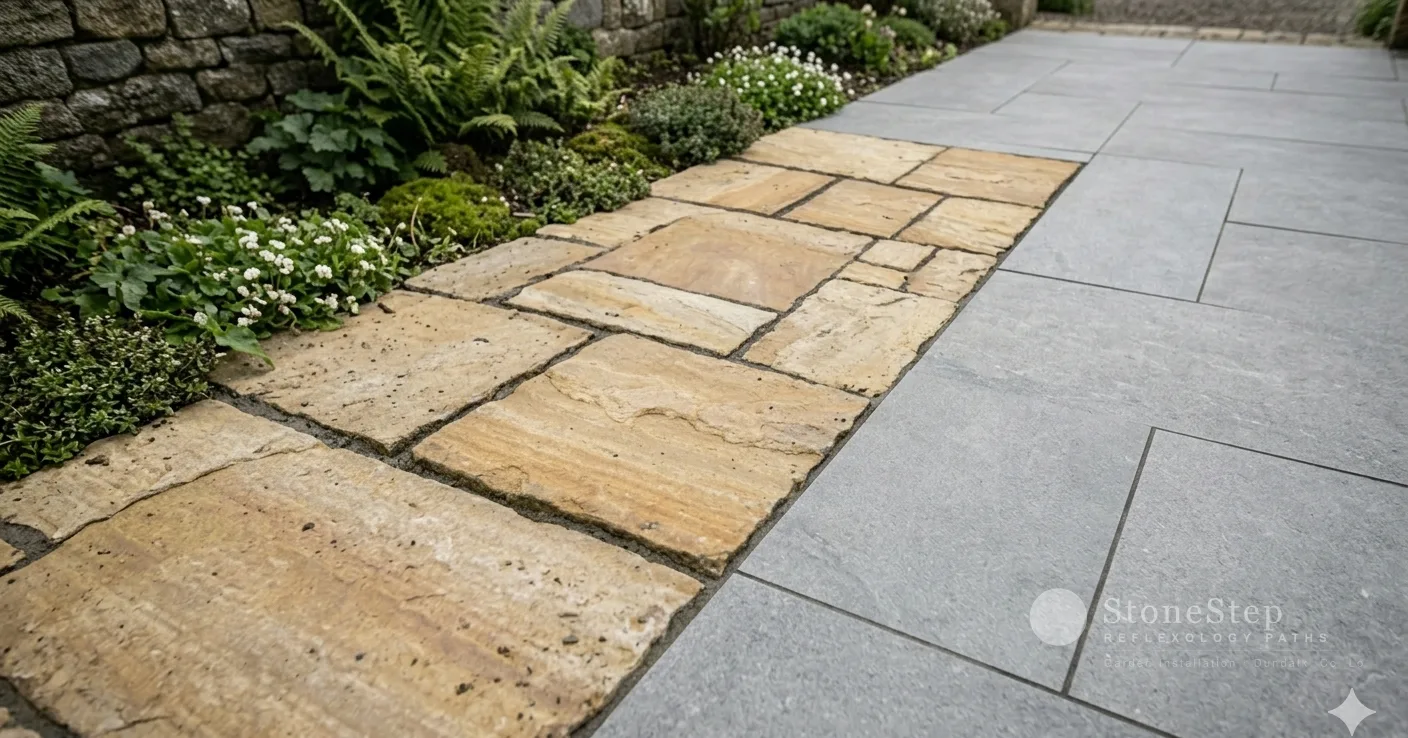
Natural Stone or Porcelain: An Outdoor Paving Guide
Porcelain outdoor paving has become significantly more common in Irish gardens over the last decade. The product has improved considerably: it is frost-resistant, non-porous, available in a wide range of finishes, and requires very little maintenance. It is a legitimate option for outdoor paving and it would be dishonest to argue otherwise.
Natural stone is something different. Not better in every respect, but different in ways that matter over time and in ways that are difficult to fully assess in a showroom.
This guide works through the practical comparison without favouring either option. The right choice depends on what you are building, where it is, and what you are looking for in a paved surface over the years you live alongside it.
What Porcelain Is
Porcelain outdoor paving is a man-made ceramic product, fired at very high temperatures from a mix of clay, feldspar, and other minerals. The firing process creates an extremely dense, low-porosity material that resists water absorption, frost, staining, and surface wear. Modern outdoor porcelain is typically 20mm thick and rated for slip resistance in wet conditions (R11 rating or above is appropriate for exterior use in Ireland).
Porcelain is a manufactured product, which means it is consistent. Every slab in a batch is the same colour, the same texture, and the same dimensions. That consistency is part of its appeal. It is also, for some people and some gardens, its limitation.
What Natural Stone Is
Natural stone, in the context of outdoor paving, refers to quarried materials: sandstone, limestone, granite, slate, and others. Each piece is cut from the ground and each carries the variations of its geological origin. No two slabs are identical. The colour shifts across the surface. The texture is inherent rather than applied.
The most widely used natural stones for outdoor paving in Co. Louth are sandstone, limestone, and granite, each covered in our stone comparison guide. For this comparison, the relevant distinction is not which natural stone but what natural stone as a category offers relative to porcelain.
The Practical Comparison
Frost resistance
Porcelain wins clearly on this measure. Its near-zero water absorption rate means there is almost nothing for frost to act on. It does not absorb moisture in the first place, so freeze-thaw cycles have very little effect.
Natural stone varies. Granite is effectively impervious to frost and performs comparably to porcelain. Limestone is denser and more frost-resistant than sandstone. Sandstone, if unsealed, is susceptible to frost damage in northeast Ireland’s winters. Sealed sandstone performs well, but the sealing needs to be maintained.
For Co. Louth gardens in exposed or north-facing positions, this is a meaningful difference. Porcelain does not require the same level of maintenance diligence that sandstone does to perform well through Irish winters.
Maintenance
Porcelain requires very little. An occasional sweep and a wash with water and mild detergent keeps it in good condition. It does not need sealing. Joints can be repointed if they deteriorate, but the surface itself changes very little over time.
Natural stone varies by type. Sandstone needs sealing every three to four years and benefits from annual cleaning. Limestone needs less attention but still requires periodic sealing and pH-neutral cleaning to avoid surface etching. Granite needs almost nothing.
If minimum maintenance is the priority, porcelain is the more straightforward choice.
Appearance over time
This is where the two materials diverge most significantly, and where the decision ultimately comes down to personal values rather than objective performance.
Porcelain does not change. The surface you see on day one is, with normal cleaning, very close to what you will have in twenty years. For people who want a controlled, consistent result that holds its appearance without intervention, this is an advantage.
Natural stone changes. Sandstone weathers and settles into its surroundings, developing a patina that is not the original surface but is better than it in the way that worn things can be. Limestone gradually acquires depth of tone. Even the mortar joints age differently from the stone around them, and the effect after a decade is something that could not have been planned at installation.
Whether that change is valued or not is a genuine question of preference. Many people who ask us about this decision find that they know the answer once the question is put plainly. Some want the surface to hold exactly as designed; others want the garden to settle into itself over time, and a stone path or patio is part of how that happens.
A porcelain patio does not feel like part of the garden. A natural stone patio, after a few years, does.
Slip resistance
Both materials can be slip-resistant when correctly specified. Porcelain with an R11 anti-slip rating is reliable in wet conditions. Natural stone with a riven finish provides good grip. The key with natural stone is ensuring the correct finish is specified: polished limestone or polished slate outdoors is inappropriate in Irish weather and should not be laid.
Porcelain provides a more consistent, certified slip rating. Natural stone provides grip through surface texture, which is effective but varies between stone types and finish options.
Cost
Installed costs for both materials in Co. Louth are broadly comparable for mid-range specifications. Porcelain materials run from €55 to €100 per square metre; natural stone from €45 to €130 depending on stone type. Installed, the range for both sits between €130 and €220 per square metre.
Porcelain requires the same sub-base preparation as natural stone. The bedding method differs slightly, as porcelain is typically laid on a full mortar bed, but the groundwork cost is similar. Do not assume porcelain is substantially cheaper than natural stone installed; the gap at material level narrows considerably once preparation and laying are factored in.
The Garden Question
There is a question underneath all of this that the technical comparison does not fully answer.
What do you want the outdoor space to be?
Porcelain produces an outdoor space that is clean, designed, and controlled. It reads as an extension of the interior, with the same level of finish management. That is right for some gardens and some households.
Natural stone produces something that belongs to the garden rather than being imposed on it. It weathers. It develops. It becomes, over time, something specific to that place and that climate.
Neither is superior. They are different things, and the decision is worth taking seriously.
We are happy to discuss both options on a site visit and will give you a direct recommendation based on your specific garden, its conditions, and what you are trying to achieve. We install both.
See our natural stone garden paving service for more on what a natural stone installation involves.
Frequently Asked Questions
Does porcelain paving add the same value to a property as natural stone? In most Irish property contexts, natural stone hard-landscaping is perceived as a more distinctive finish than porcelain. That said, well-specified, well-laid porcelain is received positively. The gap in perceived quality has narrowed as porcelain paving has become more common and the quality of the product has improved.
Can porcelain and natural stone be combined in the same garden? Yes, and this can be effective. A porcelain patio for the main entertaining area and a natural stone path connecting it to the house or garden combine the low-maintenance surface of porcelain with the character of natural stone where it will be most seen and most walked.
Is porcelain paving more environmentally responsible than natural stone? This is genuinely complex. Porcelain production is energy-intensive. Natural stone quarrying has landscape impacts but requires no manufacturing process. Some porcelain products incorporate recycled content, which improves their environmental profile. Neither material is clearly superior on environmental grounds.
What goes wrong with porcelain paving installations? The most common failure modes are the same as for any paving: inadequate sub-base preparation and poor drainage. Porcelain’s non-porosity means that water that does not drain correctly has nowhere to go, which can create frost-lift in the bedding layer underneath the slab. A properly prepared sub-base with correct falls is as important for porcelain as for natural stone.
Have a question about your garden?