
Natural Stone vs Block Paving: Which Is Better for Irish Gardens?
Block paving and natural stone are the two most common choices for residential garden hard-landscaping in Ireland. They are also, in most respects, quite different things, built from different materials, designed for different purposes, and behaving differently over the years you live alongside them.
This guide sets out an honest comparison. Not a sales case for one over the other, but the practical differences that matter for a garden in Co. Louth or anywhere across northeast Ireland.
What Each Material Actually Is
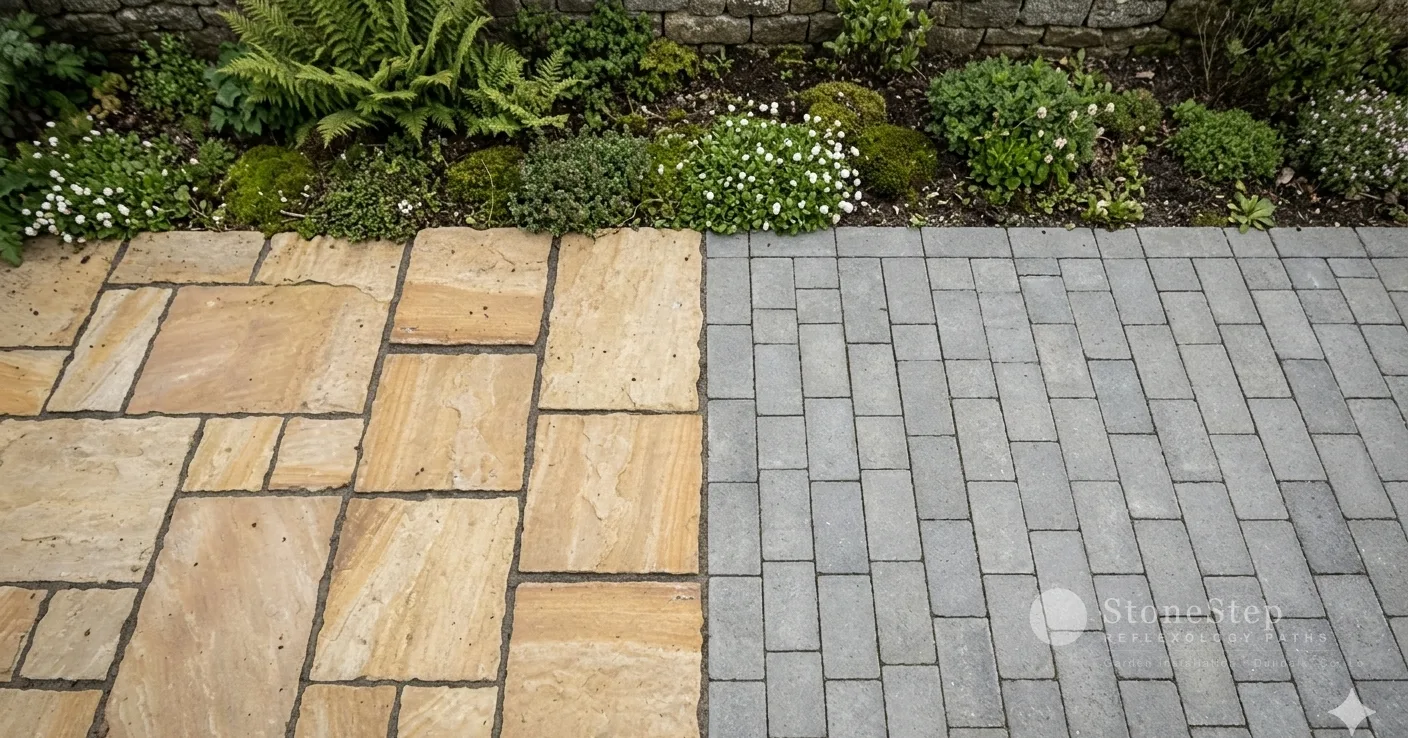
Block paving is manufactured concrete, pressed into individual blocks. It is designed primarily for driveways and high-traffic areas where its uniformity, dimensional accuracy, and resistance to vehicle loads are genuine advantages. It is available in a wide range of colours and patterns. The blocks are identical by design.
Natural stone is quarried from the ground, including sandstone, limestone, granite, slate, and others. Each is cut into slabs or pavers, and laid individually. No two pieces are exactly the same. The variation is inherent to the material, not a defect in it.
Those two sentences capture, more than anything else, the fundamental difference in what each material is.
Cost: Upfront and Over Time
Block paving is cheaper to install. Expect to pay €80 to €130 per square metre installed for a standard block-paved garden path or patio in Co. Louth. Natural stone, installed to a proper standard, typically runs €130 to €220 per square metre depending on the stone type.
That gap is real, and for budget-sensitive projects it matters.
What changes the calculation is the time horizon. Block paving for driveways, which is what the product is designed for, and it performs very well over decades under vehicle loads. In garden settings, where the paving is seen every day from the house and lived against year-round, the behaviour of the material over time becomes more significant.
Block paving fades. The colour you choose from a sample board is rarely the colour you are looking at in ten years. Staining from leaf tannins, algae, and general weathering tends to be uneven across a block-paved surface, creating a patchy appearance. Individual damaged blocks can be replaced, but matching weathered block paving with new material is rarely seamless.
Natural stone does not fade in the same way. Sandstone weathers and settles into its surroundings. Limestone develops a patina. Both tend to look more themselves, more at home in a garden, as the years pass.
The practical consequence is that many homeowners who choose block paving for its lower upfront cost find themselves considering replacement within fifteen years in a garden setting, while a well-laid natural stone path installed at the same time would have another thirty years of useful life ahead of it.
Performance in Irish Weather
Both materials can perform well in Irish weather when correctly installed. The difference lies in how they behave on an inadequate sub-base, and how they respond to the specific climate conditions of northeast Ireland.
Frost and freeze-thaw cycles. Co. Louth experiences enough frost each winter for freeze-thaw damage to be a real concern. Water enters small cracks or porous surfaces, freezes, expands, and opens the crack wider. Unsealed sandstone is more susceptible to this than sealed sandstone, limestone, or granite. Standard block paving can also suffer surface spalling if water penetrates surface micro-cracks. The solution in both cases is the same: a properly drained surface and, for porous natural stone, appropriate sealing.
Clay soil movement. Louth’s clay-heavy ground is the more significant local factor. Clay expands when wet and contracts as it dries. A path or patio on inadequate foundations will reflect that movement regardless of whether the surface material is stone or block. This is an argument not for one material over the other, but for taking sub-base preparation seriously on either.
Moss and algae. Both materials are susceptible to moss growth in shaded, north-facing positions. Textured natural stone surfaces, particularly riven sandstone, tend to hold grip when mossy better than the smoother faces of many block paving products. Annual treatment with an appropriate patio cleaner controls growth on both.
Appearance: Now and in Twenty Years
This is where the two materials diverge most clearly, and where the decision is ultimately made for most people.
Block paving is consistent on the day it is laid. That consistency is also its limitation: every block is the same, and the uniformity reads as manufactured rather than natural. In a garden setting, beside planting and organic materials, block paving tends to look like what it is.
Natural stone has variation. Every slab has a slightly different tone, texture, and character. Hand-laid, with stones that respond to the garden around them, a stone path or patio has a quality that feels placed rather than applied. It suits period properties, contemporary designs, and the kind of Irish garden that has evolved over years, and it improves with age rather than declining.
This is not a subjective preference. It is a consistent observation among homeowners who have lived with both materials. Block paving looks best when new. Natural stone looks better at fifteen years than it did at one.
Maintenance
Both materials require some maintenance. The comparison is relatively balanced.
Block paving requires periodic weed removal from joints (weeds establish readily in the sand joint of block paving), re-sanding of joints every few years as the kiln-dried sand washes out, and occasional power washing. Individual damaged blocks can be replaced.
Natural stone requires annual brushing and periodic washing with a diluted patio cleaner. Sandstone and limestone benefit from resealing every three to four years. Joints may need re-pointing every ten to fifteen years. Granite needs almost no maintenance beyond cleaning.
Neither is significantly more demanding than the other. The difference is in the nature of the maintenance task: block paving tends to need attention to joints and weeds; natural stone to surface sealing and pointing.
Which Is Right for Your Garden?
Block paving makes sense for driveways, large car standings, and high-traffic utility areas where its strength and cost-effectiveness are the relevant factors.
For garden paths, patios, and any paved area that will be seen daily and lived against through Irish seasons, natural stone is the more considered choice. The higher installation cost reflects a material that will still be looking right in thirty years, that improves rather than deteriorates with weathering, and that brings a quality to a garden that concrete block cannot replicate.
That is not a sales point. It is what the material does.
For Co. Louth-specific guidance on stone options and what the installation process involves, see our stone path installation guide and our natural stone garden paving service.
Frequently Asked Questions
Can block paving be replaced with natural stone later? Yes. Old block paving can be lifted and the area re-prepared for natural stone installation. The sub-base may need to be deepened or regraded depending on how it was originally built. If you are considering this as a future project, it is worth asking an installer to assess the existing base during any site visit.
Does natural stone add more to property value than block paving? In most Irish property contexts, yes. Natural stone hard-landscaping, particularly in a garden setting, reads as a quality finish that contributes to a property’s overall presentation. Block paving in a garden is less distinctive.
Is block paving always cheaper than natural stone? At installation, yes, for most specifications. Over a twenty-year period, the gap narrows when replacement costs for block paving in garden settings are factored in against the lower maintenance and longer service life of natural stone.
What about porcelain paving as a third option? Porcelain is worth considering for patios where low maintenance and a very clean, contemporary finish are the priorities. It does not weather and develop in the way natural stone does, which some people find appealing and others find limiting. See our natural stone versus porcelain comparison for a fuller breakdown.
Have a question about your garden?