
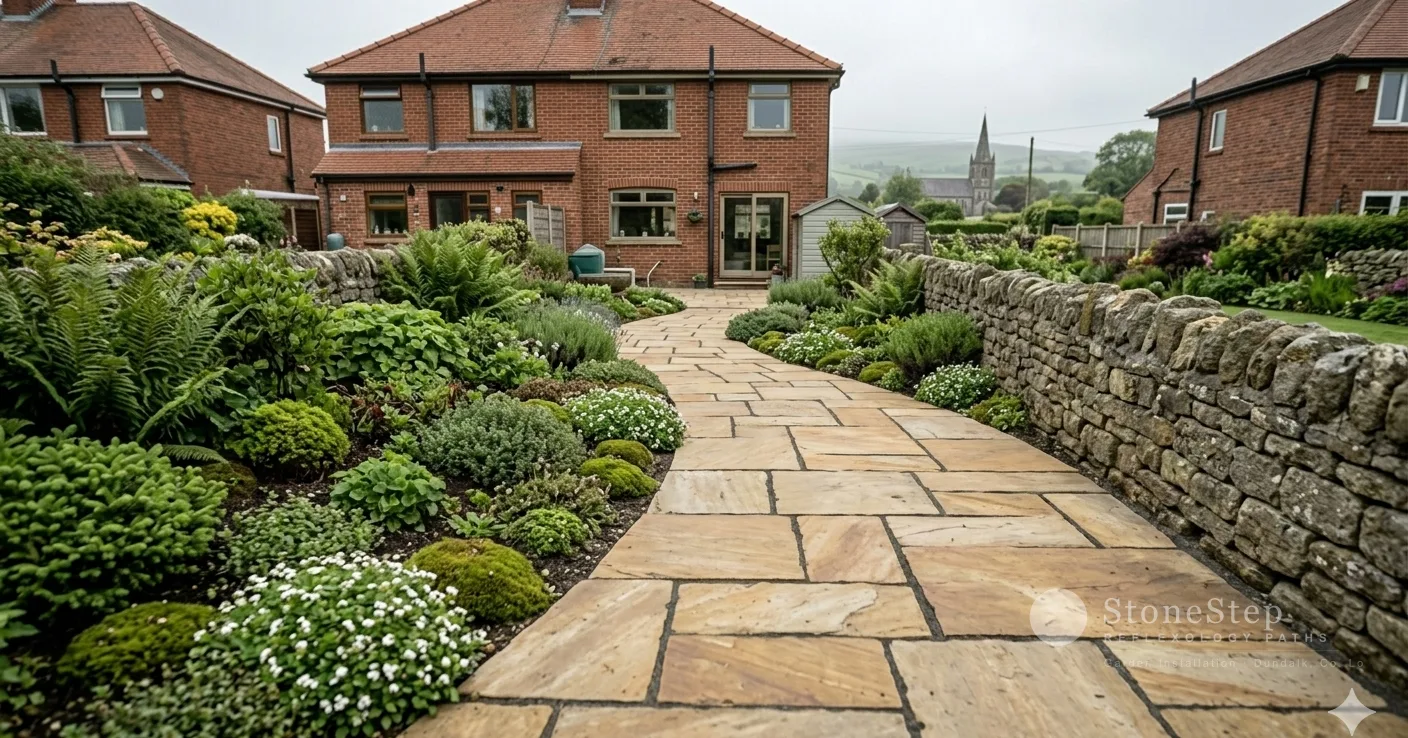
Why Natural Stone Has Found Its Place in Dundalk
Something has been changing quietly in Dundalk gardens over the last few years. It does not make headlines. It is not the product of a single trend or a home renovation programme. But it is consistent enough to notice.
More homeowners in Dundalk and across Co. Louth are choosing natural stone for their garden paths and patio surfaces. Not all of them. Not even most of them yet. But more than before, and for reasons that are worth understanding.
The Shift Away from Quick Decisions
For much of the past two decades, the path from a garden project decision to a completed installation in Dundalk was short. A quote, a date, a crew in for a day or two. The emphasis was on getting it done and getting it done affordably. Block paving was the dominant choice, partly because it was the default and partly because the upfront cost was lower than natural stone.
The results were fine, for a time. But block-paved garden paths and patios do not age in the same way that natural stone does. After a decade, many Co. Louth homeowners were looking at faded, stained, and sometimes cracking surfaces that needed significant attention, or replacement, well before they had expected to.
That experience has changed the way some Dundalk homeowners approach the same decision the second time around.
The question has shifted from what is cheapest to lay now to what will still be worth living with in fifteen years. And on that question, natural stone has a clear answer.
The Property Context
Dundalk’s housing stock creates a particular opportunity for natural stone.
The Victorian and Edwardian terraces of the town centre, with their red-brick facades and established walled gardens, have an affinity with natural stone that block paving rarely achieves. Warm buff or golden sandstone against red brick, with planting softening the edges: this is a combination that looks as though it belongs. It is not a designed effect so much as a restoration of proportion that was always there, waiting for the right material.
The same is true of the older semi-detached properties in the suburbs south of the town, and of the period cottages that survive in the surrounding areas of north Louth. These buildings have a material honesty that block paving tends to work against. Natural stone works with it.
This is not simply an aesthetic observation. When a garden feels coherent, when the hard-landscaping is genuinely appropriate to the house and the setting, the effect is one of restored value rather than added feature. Homeowners notice it. Visitors notice it. It registers differently from a surface that is merely functional.
The Outdoor Living Shift
A second factor is the change in how Dundalk homeowners use their gardens.
The period from 2020 onward accelerated a shift that was already underway: outdoor spaces became genuinely important parts of the home rather than seasonal afterthoughts. People invested time in their gardens, discovered what the garden offered, and began to think more carefully about what they wanted it to be.
A garden path that is just a way to get to the back gate from the back door is a different thing from a path that is a reason to walk in the garden. Natural stone, particularly when laid through planting, encourages the second relationship. The surface has character. It changes with the light and the season. Walking on it is different from walking on a uniform manufactured surface.
This sounds like a small thing. Over the course of years of daily use, it is not a small thing.
The Long View on Value
A third factor is a more careful reckoning with cost over time.
A natural stone path in Dundalk, properly installed on a sound sub-base, should require no structural attention for thirty to fifty years. The surface improves rather than deteriorates. The maintenance cost is low: annual cleaning, resealing every few years for sandstone or limestone.
The comparison with block paving, laid for less and replaced or significantly repaired within fifteen years, is one that more homeowners are now making explicitly rather than discovering after the fact. The total cost of ownership calculation favours natural stone across the medium term, not just as a lifestyle choice but as a financial one.
This is a shift in thinking rather than a shift in material availability. Natural stone has always been available in Co. Louth. What has changed is the willingness to think past the installation cost to the cost of living with the result.
What Natural Stone Feels Like in a Dundalk Garden
It is worth saying something direct about the experience, because it is the experience that keeps people satisfied with the decision rather than the analysis of it.
A well-laid natural stone path in a Dundalk garden feels settled. It does not look as though it was recently installed. The material has a quality of weight and permanence that manufactured surfaces do not have. The variation in tone and texture across the surface reads as belonging to the garden rather than being applied to it.
After a season or two, the stone begins to acquire the character of the specific place: a particular patina where the morning light catches it, a slight darkening at the north-facing edge where moisture lingers longer. These are not imperfections. They are what natural stone does when you give it time and leave it to itself.
That is ultimately what is behind the shift in Dundalk. Not a trend, not an aesthetic fashion. A recognition that some things genuinely get better with time, and that a garden path is one of them.
For more on stone options and what an installation in Co. Louth involves, see our stone path installation guide and our stone type comparison.
Request a free site visit in Dundalk →
Frequently Asked Questions
Which natural stone suits Dundalk’s red-brick terraced homes best? Warm buff or golden Indian sandstone has the strongest affinity with red brick, picking up the warmth of the brickwork rather than contrasting with it. Blue-grey limestone is a more formal choice that can also work well, particularly on larger properties where a cooler, more restrained palette suits the scale. We discuss stone selection in relation to the specific property on every site visit.
Is natural stone significantly more expensive than block paving in Dundalk? The installation cost is higher upfront. The gap narrows considerably when replacement or significant repair costs for block paving within fifteen years are factored into the comparison. See our stone path cost guide for a full breakdown.
Does natural stone require much maintenance in Co. Louth’s climate? Sandstone needs sealing on installation and every three to four years thereafter. Limestone needs less frequent sealing but benefits from it. Granite needs almost none. All natural stone benefits from annual brushing and an occasional wash. This is a low-maintenance material, not a no-maintenance one.
How long does a natural stone path installation take in Dundalk? A standard residential garden path takes two to three days on site. See our stone path installation timeline for a full account of what each stage involves.
Have a question about your garden?