
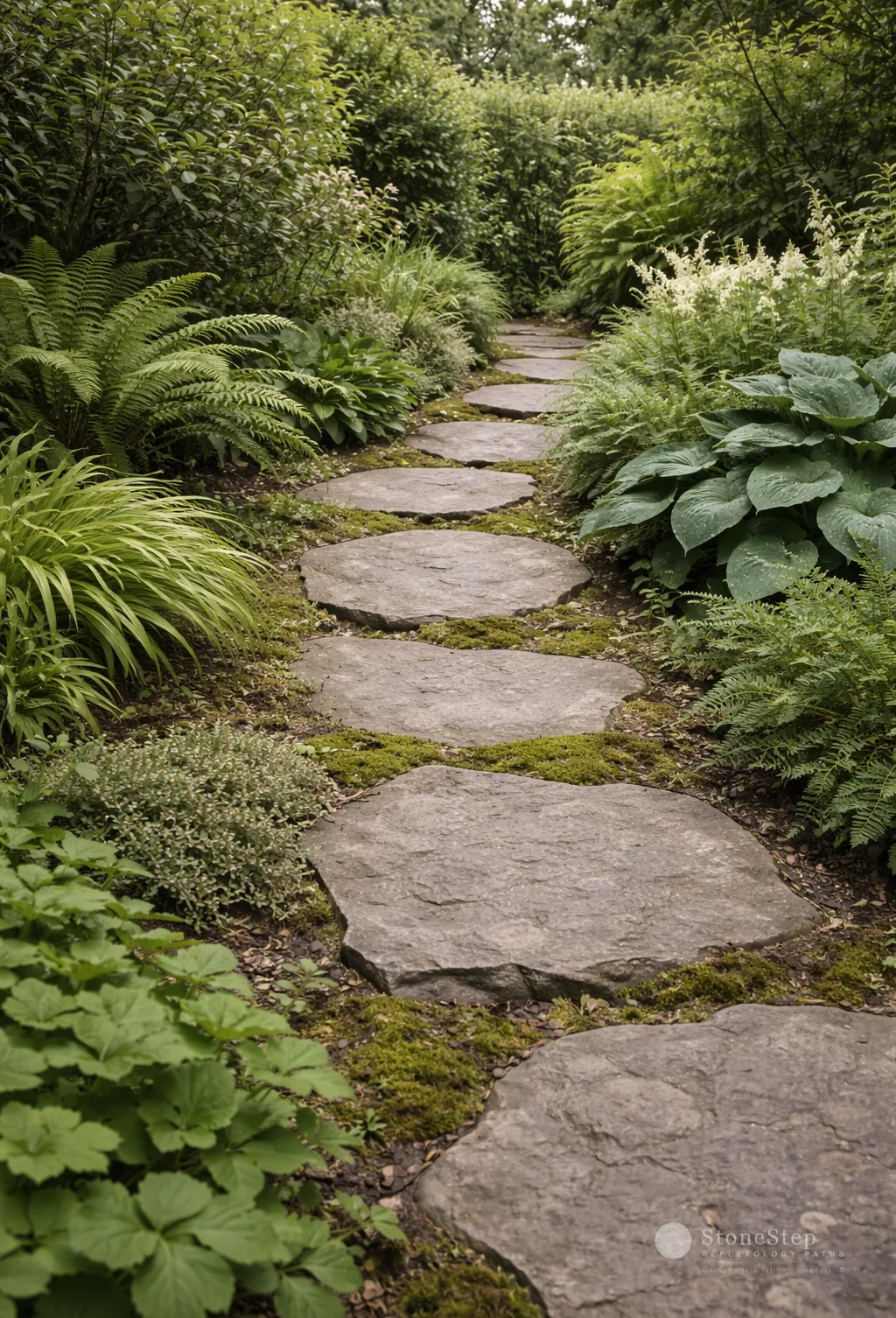
Laying a Japanese Garden Path in an Irish Garden
Japan and Ireland share something that many people do not immediately notice: a deep familiarity with rain.
Both countries have climates shaped by oceanic moisture. Both have garden traditions that have developed in response to persistent wet conditions rather than in spite of them. The tea garden path, or roji, was designed to be walked on wet ground, through a garden that was supposed to be damp, where fallen leaves on the stones and moss growing between them were not signs of poor maintenance but elements of the composition.
This is worth knowing before attempting to translate the roji tradition into a Co. Louth garden. It translates more directly than you might expect.
What the Roji Actually Is
The roji is not simply a path. It is a transition. The word means, approximately, dewy ground, and the tea garden path was designed to carry the guest from the ordinary world into the refined, slowed-down world of the tea ceremony. Every element of its design was intended to produce a quality of attention in the person walking it.
The path meandered, so that the destination was not immediately visible. It moved through planting rather than past it. The stepping stones, or tobi-ishi, were placed at a spacing and in arrangements that regulated the walker’s pace: set closer together to slow the walk, further apart where the view deserved a pause. The stones themselves were chosen for their character, not their uniformity. No two stones in a traditional roji are the same.
The aesthetic principle behind all of this is wabi: a quality of beauty found in imperfection, impermanence, and incompleteness. A roji that looked too finished, too symmetrical, too obviously designed, would have defeated its own purpose.
This is useful to understand for the Irish garden context because it clarifies what is worth attempting and what is not.
What Translates Directly
Several roji principles translate almost without adaptation to a Co. Louth garden.
The use of moss. In Japan, moss growing between and around stepping stones is cultivated and valued. In Ireland, moss grows on and around stones without any encouragement whatsoever. What Japanese garden designers spend considerable effort and water creating, an Irish climate produces without assistance. A stepping stone path through an established garden in Co. Louth will have moss at its margins within a season or two. This is not a problem to be managed but a characteristic to be accepted and worked with.
The value of dampness and shadow. The roji was designed for shaded, damp ground. Ferns, hostas, and the structural character of north or east-facing planting are entirely at home in a Japanese-influenced path design. The cooler, greener palette of a shaded Co. Louth garden suits the roji aesthetic better than a sunny, dry-climate Mediterranean arrangement would.
Irregularity as a design principle. Stepping stones in a Japanese garden are never uniform. They are chosen for flatness sufficient to stand on safely, but varied in size, shape, and tone. In Co. Louth, natural limestone flags, irregular sandstone pieces, and locally sourced flat stones all provide exactly the kind of material character that makes a roji-influenced path look as though it belongs in a garden rather than being placed there.
Pace as a design intention. Setting stepping stones at a spacing that requires a slightly shortened stride and a downward glance does what the original roji intended. It slows the walk. It produces a quality of attention. The garden is experienced rather than crossed.
What Requires Honest Adaptation
Transplanting the roji whole into an Irish garden produces something Japanesque rather than Japanese. The distinction matters.
Elements that are specific to the Japanese climate, topography, and cultural context do not transfer directly. Raked gravel in the Japanese garden represents water or cloud; in a northwest European garden, it fills with leaf litter, grows moss, and requires continuous intervention to maintain the raked pattern. It is a beautiful idea in the wrong climate.
Similarly, the formal stone lanterns, water basins, and architectural elements that populate image searches for Japanese gardens are cultural objects with specific meanings in their context. Used without that context, they read as decoration rather than element. A stone lantern on a Dundalk garden path is furniture arranged to look Japanese. It is not roji.
What is worth taking from the roji tradition for an Irish garden is not the objects but the principles: the meandering path, the stones chosen for character, the planting that enfolds rather than borders, the pace built into the spacing of the stones, the acceptance of dampness and moss as part of the garden’s nature rather than problems to be solved.
How We Approach It
When a Co. Louth client asks for a Japanese-influenced garden path, the conversation starts with these questions.
What is the path doing? Is it the main connection between the house and the back garden, or is it a secondary route through planting? A main approach path cannot have the irregularity of a true roji stepping stone arrangement; it needs reliable footing in all weather conditions. A secondary path, where you walk slowly and with awareness, can carry much more of the roji spirit.
What is the existing planting context? A Japanese-influenced stepping stone path works best when the planting around it has some of the right qualities: low growing, textural, green-dominant, with moisture-tolerant species. Trying to introduce this path style into a garden dominated by large-scale formal planting requires more redesign than just the path.
What is the stone? In Japan, the most valued roji stones were found rather than quarried: river stones, flat-faced boulders from stream beds, pieces with a history of exposure. In Co. Louth, reclaimed limestone flags, irregular pieces of local stone, and river-rounded cobbles all carry some of that quality. The decision on stone in a roji-influenced path is made by character rather than by specification.
The result, when it works, is a path that could not exist anywhere except in the garden it was built for. That is the test. Not whether it looks Japanese, but whether it looks as though it grew where it is.
For more on stone selection and how path installation works in Co. Louth, see our stone path installation guide and our stone type comparison.
If you are interested in a wellness garden that incorporates reflexology path elements alongside roji-influenced design, see our wellness garden design guide.
Frequently Asked Questions
Can a Japanese-style path work in a small Co. Louth garden? The roji was actually developed for small gardens, specifically the confined garden between a gate and a tea house. The principles translate readily to small Irish back gardens. A path of four or five stepping stones through a planted 20 square metre garden can carry the full spirit of the tradition if the stones are right and the planting supports them.
What stone works best for stepping stones in an Irish garden? Flat, irregular limestone flags are the closest material available in Co. Louth to the character of traditional roji stepping stones. They have the natural quality of found stone rather than quarried regularity. Flat sandstone pieces and reclaimed flagging are also appropriate. We avoid uniform sawn slabs used as stepping stones; the regularity reads as paving rather than stone.
Will a stepping stone path be safe in wet and icy conditions? A well-laid stepping stone path, with stones set firmly at grade and spaced for comfortable walking, is safe in wet conditions. In icy conditions, the same caution applies as to any outdoor stone surface. Textured stone with a riven or naturally rough surface provides better grip than polished stone; we select for this in any path that will be walked regularly in winter.
How do I prevent moss becoming a slip hazard on stepping stones? Some moss growth between stepping stones is entirely compatible with the aesthetic and with safety. Moss on the walking surface of the stones themselves can become slippery when wet. Annual treatment with a proprietary patio cleaner keeps the stone surfaces clear while allowing moss to establish at the edges and margins, which is where it belongs in this style of garden.
Have a question about your garden?