
How Reflexology Paths Work: Stone, Texture, Foot
A reflexology garden path is not simply a path made from pebbles. The stones are not placed at random, the textures are not decorative, and the experience of walking it is not incidental.
This post explains the thinking behind how a reflexology path is designed and built: the relationship between stone selection, surface zoning, and the way the foot actually receives and responds to what is underfoot.
The Foot as a Receiver
The sole of the foot contains over 7,000 nerve endings, more than almost any other area of comparable size on the body. These nerve endings are connected to proprioceptors, the sensory receptors that feed the nervous system with continuous information about pressure, position, and movement.
In everyday life, most of that capacity goes largely unstimulated. Modern footwear, combined with flat, hard surfaces, reduces the foot’s contact with varied ground to something close to zero. The foot moves through the day in a kind of sensory quiet, pressing against a consistent surface that provides no real information.
A reflexology path changes this. The varied texture of rounded stones, different in size, density, and placement across the path, activates the foot’s nerve endings continuously and in a changing pattern as you walk. The nervous system, which is calibrated to respond to novelty and variation, engages. The result, after a few minutes of slow, attentive walking, is a quality of relaxation and mental quiet that is measurably different from standard walking.
Reflexology as a formal therapy maps specific points on the sole to corresponding organs and body systems, and targeted pressure on these points forms the basis of clinical treatment. A reflexology path engages those same points through sustained, passive stimulation rather than targeted manual pressure. The mechanism is different; the territory it works on is the same.
How Stone Selection Shapes the Experience
The feel of a reflexology path is determined primarily by the stone used to build it. This is not an aesthetic decision. Each stone type provides a different quality of stimulation, and a well-designed path uses that variation intentionally.
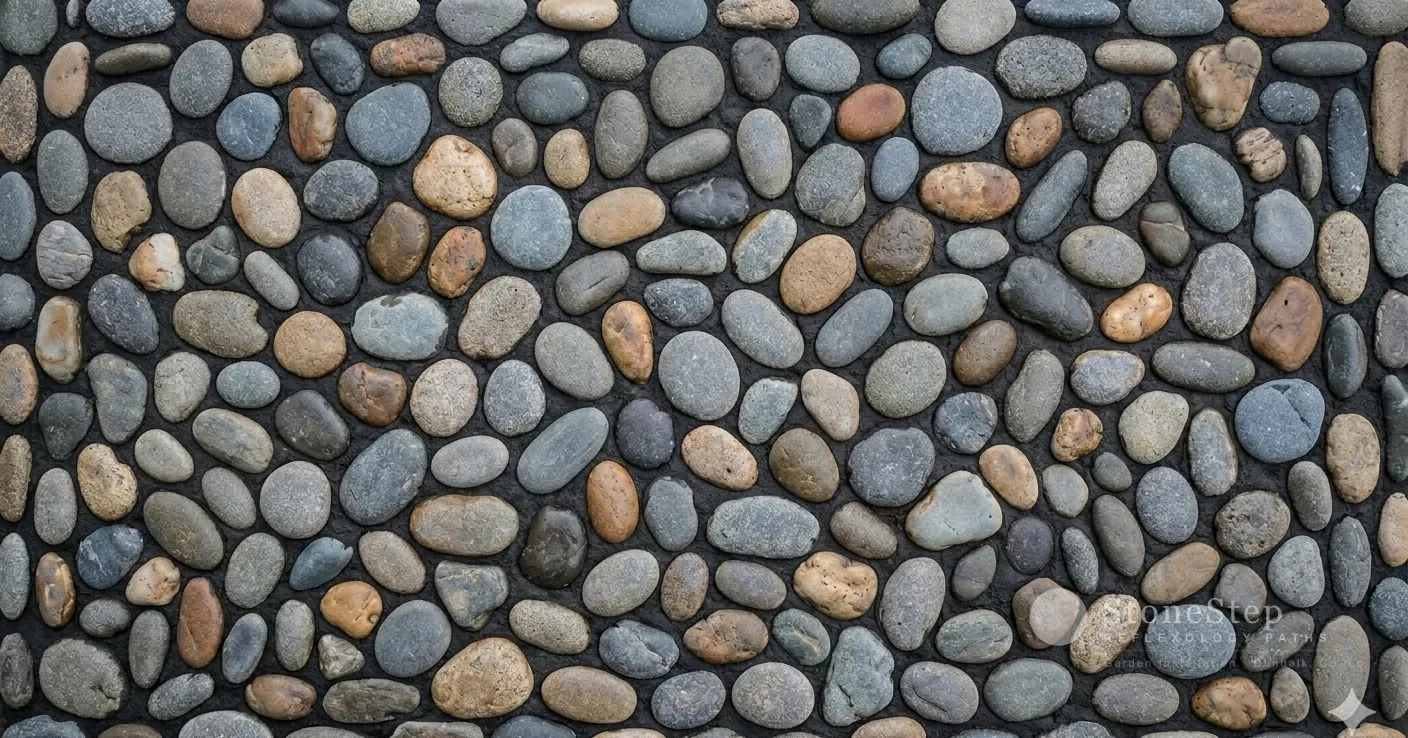
Rounded river pebbles are the foundation material in most reflexology paths. Their smooth, curved surfaces press against the foot’s sole without sharp edges, providing a sustained, rolling stimulation as the weight shifts across them. They work particularly well under the arch and the ball of the foot. Natural Irish river pebbles, collected from riverbeds where they have been rounded by water over years, have a quality of surface contact that is different from commercially tumbled stone. They are unpredictable in small ways. That unpredictability is useful.
Larger smooth cobbles provide a firmer, more concentrated pressure. Set with their flattest face uppermost, they engage fewer points at once but with more weight behind each contact. A section of larger cobbles after a run of smaller pebbles creates a distinct change in sensation, as if the path is asking more of the foot.
Mixed-size arrangements are the most effective approach for stimulating the widest range of reflex points. Where small and medium pebbles are packed closely together with occasional larger stones rising slightly above the general surface, the foot navigates a varied topography with every step. No two footfalls are identical. The nervous system does not habituate.
The Role of Zoning
A reflexology path is typically divided into zones, each with a distinct surface character. This is not visible from a distance; the path reads as a unified whole. But as you walk it, the surface changes underfoot in ways that can be felt clearly.
A standard three-zone design moves through:
An entry zone of medium rounded pebbles, close-packed. This is where the feet begin to warm up. The stimulation is consistent and not demanding. It prepares the foot for what follows.
A central zone of varied sizes: smaller pebbles interspersed with larger cobbles at irregular intervals. This is the most active section of the path. The foot is constantly adjusting, weight shifting in small ways to accommodate what is underfoot. This zone engages the arch, the ball of the foot, and the heel in rapid succession.
A closing zone of larger, smoother stones with wider spacing. The stimulation reduces. The foot has time to settle. Walking this section at the end of a barefoot circuit produces a different quality of sensation than walking it at the start.
The transition between zones is gradual rather than abrupt. A sudden change from fine pebbles to large cobbles is uncomfortable in a way that is not beneficial. Good zone design makes the transitions readable by the foot without being consciously noticed by the mind.
How to Walk a Reflexology Path
The walk is slow. That is the first and most important thing.
A reflexology path walked at normal pace provides surface novelty but relatively little therapeutic benefit. The nerve endings need time to respond to each contact. Walking slowly, placing the foot with deliberate attention, allows the full sole to make contact with the varied stone surface rather than the heel and ball alone.
Barefoot is the correct approach. Socks reduce the sensory input substantially; thin-soled shoes reduce it further. The point of a reflexology path is the direct conversation between the sole of the foot and the stone surface. Anything between them is, to some degree, a conversation held through a wall.
Five to ten minutes, walked slowly and without distraction, is enough for a meaningful session. Many people find the most useful time is in the morning, before the working day, or in the evening when the nervous system is looking for a way down from the activity of the day.
The first few sessions will feel more intense than later ones, particularly under the arch if that area carries tension. This is normal. The path is not comfortable in the way a flat surface is comfortable. It is stimulating, and stimulation and comfort are not the same thing.
The Design as a Whole
A reflexology path is built to be walked on a particular way. The stone selection, the zone design, the width, and the length are not arbitrary. They are the result of understanding what the foot is capable of receiving and designing a surface that makes the most of that capacity without overwhelming it.
At StoneStep, we work through the design brief with each client before we build. The garden, the intended use, the age and physical condition of the people who will walk it, and the visual relationship to the wider planting all shape what we build.
For more on the installation process and what a bespoke path involves, see our reflexology garden paths service. For cost guidance, see our reflexology path cost guide.
Request a free design consultation →
Frequently Asked Questions
Does a reflexology path need to be walked in a particular direction? No, though many people find the experience more satisfying walked in one direction, from the entry zone through to the closing zone, repeated as a circuit. Walking it in both directions is equally valid. What matters more than direction is pace and attention.
Can children use a reflexology path safely? Yes. Children’s feet are highly receptive to varied textures. A path built with smooth, rounded stones and no sharp edges is safe for children, and many find it instinctively engaging. The only consideration is ensuring the stones are well-set, with no loose pieces that could shift underfoot.
Is the path beneficial if you have existing foot problems? For most minor foot concerns, regular use of a reflexology path is beneficial. Anyone with diabetes, peripheral neuropathy, plantar fasciitis, or any condition that affects sensation or circulation in the feet should take advice from their GP before beginning. A stone path that cannot be felt correctly due to reduced sensation does not provide the intended benefit and may create an unrecognised hazard.
How is a reflexology path different from simply walking on gravel? The difference is in the stone selection and the intentionality of the surface design. Loose gravel shifts underfoot and does not provide consistent contact. Sharp aggregate can cause discomfort rather than stimulation. A properly built reflexology path uses smooth, rounded stones set firmly in a mortar bed, sized and arranged to engage the foot’s reflex points through graduated, sustained pressure rather than sharp or random contact.
Have a question about your garden?