
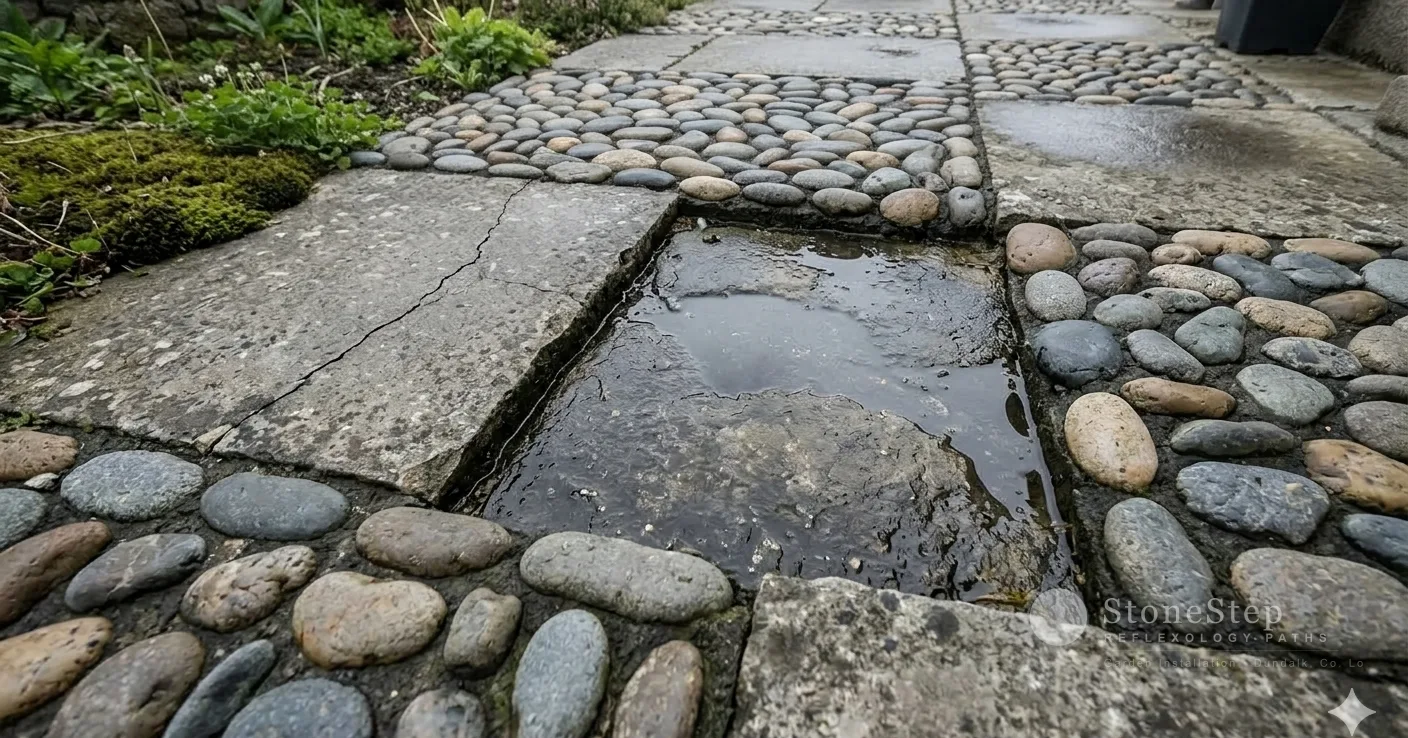
Cracked or Sinking Paving: When to Let It Go
Some paving can be repaired. A lifted slab re-bedded. A crumbling joint repointed. A single cracked stone replaced without disturbing the rest of the surface.
But some paving has quietly had its time. The cracks keep coming back. The same sections sink again after they have been lifted and re-levelled. The surface has aged in a way that no amount of maintenance can reverse.
The difficulty is knowing which you are looking at. This guide works through the signs that distinguish a patio or path that deserves repair from one that deserves to be replaced, and the questions worth asking before you decide.
What Causes Paving to Fail
Most paving problems begin below the surface, not above it.
When a patio or path is laid, the long-term performance of the surface is determined primarily by what is done in the ground before the first stone goes down. The sub-base specification, the drainage design, and the bedding method are what hold the surface stable through the seasonal cycle of wet and dry, freeze and thaw, that Co. Louth imposes on everything laid in the ground.
When those foundations are inadequate, the ground’s natural movement travels upward. Clay soil expands when saturated and contracts as it dries. Water that does not drain correctly sits beneath the paving and freezes in winter, expanding and pushing the surface above it. These are not unusual events in a northeast Irish garden. They are the annual norm.
A paved surface laid on a proper sub-base will absorb these forces without visible effect. One laid on an inadequate base will show you the problem within a few years, and will continue to show you a version of the same problem however many times it is patched.
Signs That Repair Is Sufficient
Not every problem with paving is structural. Some common issues are genuinely superficial and worth repairing.
An isolated cracked slab. One cracked stone in an otherwise stable, level, well-draining surface is an isolated event. The slab can be lifted, and a replacement set in the existing bedding or re-bedded with fresh mortar. If the surrounding slabs are sound and the crack has not reappeared in the same location previously, this is a repair job rather than a replacement.
Open or crumbling joints. Joint failure is a maintenance issue in a surface that is otherwise holding. Mortar joints open over time, particularly in paths and patios laid more than ten years ago, as the original mortar dries, shrinks, and eventually crumbles at the surface. If the slabs themselves are level, stable, and not rocking underfoot, repointing the joints is a worthwhile investment that extends the surface’s life by several years.
Surface staining or algae. Organic growth, leaf tannin staining, and ingrained grime are all cosmetic concerns. A professional clean, treatment with an appropriate stone-safe cleaner, and resealing for porous natural stones will address the appearance without any need for structural work.
One or two rocking slabs in an otherwise stable surface. Where a slab has lost its contact with the bedding beneath it but the surrounding slabs are sound, the rocking stone can be lifted, the bedding corrected, and the slab reset. This is a straightforward repair on a surface that is otherwise performing well.
Signs That Replacement Is the Better Decision
These are the situations where repair treats the symptom rather than the cause, and where the cost of continued patching will eventually exceed the cost of doing the job properly.
Recurring problems in the same areas. If you have already had sections of paving repaired and the same issues have reappeared, the underlying cause has not been addressed. A slab that has sunk, been re-bedded, and sunk again is reflecting what the ground beneath it is doing. The ground is not going to stop.
Multiple rocking or sunken slabs across a large area. A single rocking slab is an isolated repair. Five or six across a 20 square metre patio represents a bedding layer failure across the surface. At that point, relaying the individual slabs is almost as much work as a full relay with corrected sub-base, and without addressing the sub-base the slabs will continue to move.
Persistent standing water. A patio that holds water after rain has either lost its drainage fall through ground movement, has a surface fall that was never correctly designed, or has joints that have broken down to the point that water is moving into the base rather than running off the surface. In all three cases, the surface needs to come up to address the root cause. Resurfacing over a wet, degraded base produces a wet, degraded result.
Structural cracking across multiple slabs. Cracks that run continuously across several slabs, diagonal cracks in stone that suggest the base has heaved beneath it, or cracks that have widened after previous repair all indicate ground movement at sub-base level. The movement will continue until the base is rebuilt correctly.
Age combined with widespread deterioration. A sandstone patio laid fifteen years ago on a poor sub-base, now showing staining, crumbling joints, three or four sunken sections, and surface spalling from frost ingress, has given what it can give. Patching individual elements while the rest continues to deteriorate is a cost that accumulates without return.
The Question Worth Asking
Before committing to either repair or replacement, there is one question that cuts through most of the complexity.
Is this paving behaving the way it is because of something that happened to the surface, or because of what was done underneath it?
A surface problem, a cracked slab, a stained stone, a broken joint, can usually be addressed on its own terms. A base problem, one where the ground is moving and the surface is reflecting that movement, cannot be patched at the surface level. It requires the surface to come up, the base to be corrected, and the surface to be relaid.
When the answer to that question is a base problem, the conversation changes from repair to replacement. And replacement done properly, with the sub-base work carried out to the correct depth and specification, produces a surface that will hold for thirty years rather than requiring attention in three.
Getting an Assessment
If you are looking at paving in a Co. Louth garden and trying to decide whether it is worth repairing, StoneStep offers free site visits across Dundalk and the wider county. We look at the surface, assess the drainage, and give you a direct opinion on which category you are in.
There is no obligation, and we will tell you honestly if the work you need is something straightforward. Not every garden visit results in a full replacement job.
See our natural stone garden paving service for more on what replacement involves, and our paving cost guide for Co. Louth for what to budget if it comes to that.
Frequently Asked Questions
Can I lay new paving over existing paving to save on removal costs? Occasionally, yes. Laying new stone directly over sound existing concrete can work if the concrete is level, structurally intact, and the drainage beneath it is adequate. The finished surface level will be raised, which sometimes creates issues at doorways or at the boundary with adjoining surfaces. We assess each site individually. More often than not, the existing base needs correction, which requires removing the old surface regardless.
Is it worth patching a patio that is going to be replaced in a few years anyway? A targeted repair to a rocking slab or crumbling joint is a small job that can buy two or three additional years of safe, usable surface without significant cost. Larger patching work on a surface that is genuinely at end of life is rarely good value.
How long should a professionally laid natural stone patio last before needing attention? A natural stone patio on a correctly specified sub-base should give thirty to fifty years of service with routine maintenance. Routine maintenance means annual cleaning, resealing porous stone every three to four years, and repointing joints as needed. Structural issues within ten years almost always trace back to the quality of the original groundwork.
Does Co. Louth’s climate make paving wear faster than other parts of Ireland? The combination of clay-heavy soil, northeast Ireland’s rainfall, and the regular freeze-thaw cycles in winter does create particular demands on outdoor paving. These are not unusual conditions for Ireland, but they make the sub-base specification and drainage design more consequential here than in locations with lighter, freer-draining soils.
Have a question about your garden?