
Garden Path Styles That Belong in Co. Louth
A garden path that looks right does not usually announce itself. It is simply there, reading as though it could not have been otherwise: as though the stone was always going to be that colour, the edge always going to sit against the planting in that particular way.
Getting there requires a degree of honesty about what the garden and the property are, and which path styles serve that rather than work against it.
Co. Louth has a more varied stock of domestic architecture than many Irish counties. Dundalk has substantial Victorian and Edwardian terraces in the town centre, mid-century semi-detached housing in the suburbs, and more recent detached developments at the edges of the town. The coastal areas, Blackrock, Carlingford, Omeath, have older cottages and rural vernacular buildings. Ardee and the inland towns have their own mix of period and contemporary housing.
A path style that is right for a rendered semi-detached in Muirhevnamor is not necessarily right for a stone cottage in Carlingford, and neither is necessarily right for a new detached house in Blackrock. What follows is a guide to the main path styles and the properties they tend to suit.
The Straight Approach Path: Period and Formal Properties
Dundalk’s Victorian and Edwardian terraces, and the larger detached period properties scattered through the county, share a formal relationship between house and garden that tends to call for a path with equal formality.
A straight approach path in light limestone or blue-grey sandstone, wide enough to walk comfortably side by side (1.2m to 1.5m), laid with consistent tight joints and a clean border to the planting beds on either side, respects the symmetry and proportion of a period house. It does not need to be severe. The natural variation in the stone surface provides character, and the planting alongside it softens the formality in proportion to how informal the planting is allowed to be.
For Victorian red-brick homes specifically, buff and golden sandstone has an affinity with the warm tones of the brickwork. Blue-grey limestone is the more considered choice where the brickwork or rendering is already cool in tone.
Period homes in Co. Louth also respond well to reclaimed stone where it is available. A reclaimed limestone or sandstone flag path, with its history already embedded in the surface, has a quality of permanence that new stone, however well chosen, cannot immediately replicate.
The Meandering Garden Path: Cottage and Rural Properties
For older cottages, rural vernacular properties, and the kind of established suburban garden that has grown into itself over decades, a straight path often reads as an imposition rather than a complement.
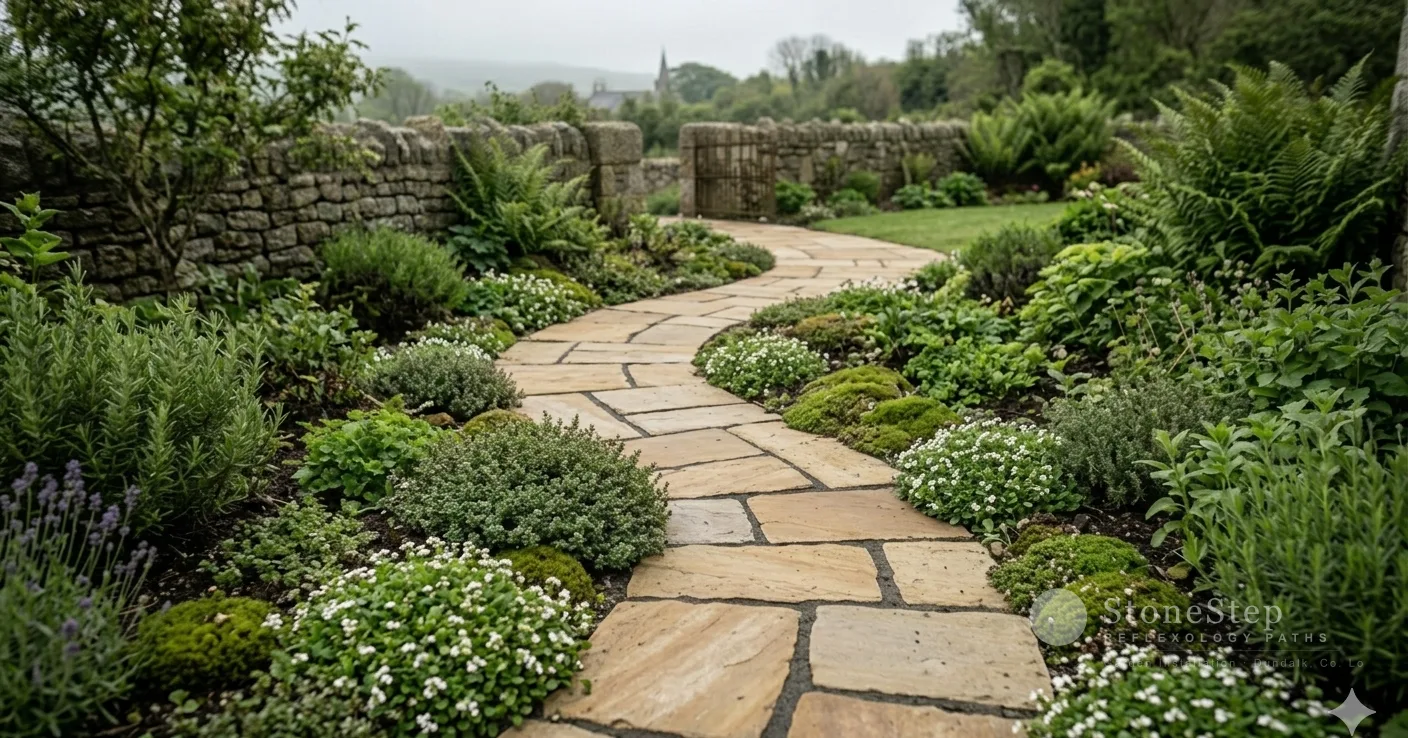
A path that follows the gentle topography of the garden, curving with the planting rather than cutting through it, belongs in these gardens in a way that a formal straight layout does not. The curve does not need to be dramatic. Even a gentle arc that avoids the geometric centre of a garden gives a path a quality of having found its own way.
Stone selection for meandering paths in rural Co. Louth gardens tends toward the more textured and varied end of the palette: riven sandstone with warm buff tones, irregular limestone flags, or mixed-stone arrangements where the informality of the surface complements the informality of the path’s route.
Width matters here too. A meandering cottage path is typically 900mm to 1m wide, not the 1.2m of a formal approach. Narrow enough to be intimate, wide enough to walk without brushing the planting on both sides with every step.
In the coastal areas of Co. Louth, particularly around Carlingford and Omeath, local stone in the planting or boundary walls creates an opportunity to carry that material into the path surface. A path that echoes the stone of the property’s walls, using the same or closely related material, reads as native to the place in a way that imported sandstone from a distance cannot quite achieve.
The Contemporary Garden Path: Modern and New-Build Properties
The more recent detached housing stock around Dundalk, Blackrock, and Drogheda tends toward clean lines, larger windows, and rendered or clad facades in neutral tones. These properties suit a more geometric approach to garden design, and a path that works with clean lines and considered materials.
A contemporary stone path in sawn limestone or sawn sandstone, with tight, consistent joints and a clear relationship to the geometry of the house and garden, sits well against a modern rendered property. The sawn finish, with its smooth, even surface, reads as designed and deliberate rather than organic and found. The stone’s natural colour variation remains, which is what distinguishes it from a manufactured surface, but the geometry and precision of the laying brings it into conversation with the contemporary architecture.
For contemporary gardens where the path connects a patio area to the rear boundary or to a side gate, the same material laid as stepping stones at a consistent spacing offers a more minimal version of the same idea, with planted ground cover filling the spaces between.
The Functional Side Path: Any Property
Every house in Co. Louth has at least one side path, and most have two. These are working paths: routes to the bins, to the back gate, to the oil tank. They are walked in the dark and in the rain. They need to hold up.
Side paths are where grip and drainage matter most, and where the temptation to economise is highest. A side path laid with inadequate drainage will become a moss-covered slip hazard within a few years. A side path laid with the same care and sub-base specification as a front approach path will be safe and functional for decades.
Riven sandstone is the most appropriate surface for side paths in Co. Louth: naturally textured, grippy when wet, relatively affordable, and available in practical widths. Most side paths are between 750mm and 900mm wide, which is enough for comfortable single-file walking with tools or bags.
The side path is not a place for statement stone choices. It is a place for good, honest installation.
Connecting Path and Patio: The Unified Garden
Where a garden has both a paved patio area and a garden path, the most considered approach is to treat them as a single scheme.
Path and patio in the same stone, or in stones that are genuinely related in colour and character, read as a unified outdoor space. Path and patio in unrelated materials, or in materials that were chosen separately at different points, often look like two different decisions that happened to end up in the same garden.
This does not mean rigidity. A limestone patio with a sandstone path can work well if the tones are complementary and the transition between the two is clean and deliberate. What rarely works is a combination that looks accidental: block paving on the patio and natural stone on the path, or two different stones selected years apart that have nothing to say to each other.
When we quote for patio and path work together in Co. Louth, we talk through the stone relationships at the outset, before anything is ordered. That conversation is much easier before the patio is laid than after it.
A Note on Scale
One consistent observation across Co. Louth gardens: paths are frequently laid too narrow.
A path of 600mm, which is standard in many budget installations, is uncomfortable to walk. Visitors walk at an angle to avoid the planted edges. Two people cannot use it simultaneously. The garden looks more constrained than it is because the path feels provisional.
A path of 900mm to 1m is comfortable for a single person. A path of 1.2m allows two people to walk side by side, which changes how the garden is used on the occasions when that matters. The cost difference between a 600mm and a 1m path is real but not large. The difference in how the path feels to use is significant.
For a fuller account of what stone path installation involves in Co. Louth, and how each stone type performs in this specific climate, see our stone path installation guide and our stone type comparison.
Frequently Asked Questions
Does a garden path need planning permission in Co. Louth? Garden paths within the curtilage of a residential property are generally considered permitted development and do not require planning permission in Ireland. If the property is a protected structure or is within an architectural conservation area, it is worth checking with Louth County Council before proceeding.
How do I choose between different stone types for a path in my Co. Louth garden? The starting point is the property and the existing materials. A stone that echoes or complements the house’s palette is almost always a better choice than one selected in isolation. After that, the conditions the path will face, how shaded it is, how much moisture it retains, and how much maintenance you want to do, determine which stone is the most practical fit. We discuss this on every site visit.
Can a path be widened after it has been laid? Yes, though it requires lifting the edge slabs on one or both sides, adjusting the sub-base, and extending the bedding and surface. It is a straightforward job but more disruptive than getting the width right at installation. We are direct about width recommendations during the quoting process precisely to avoid this scenario.
What is the best stone for a path beside the sea in Co. Louth? Coastal positions in Co. Louth, particularly around Carlingford and the Cooley Peninsula, experience more persistent salt spray and moisture than inland gardens. Granite is the most resilient stone in these conditions. Dense limestone performs well when sealed. Sandstone in coastal positions requires diligent sealing. We take the specific site conditions into account when making stone recommendations.
Have a question about your garden?