
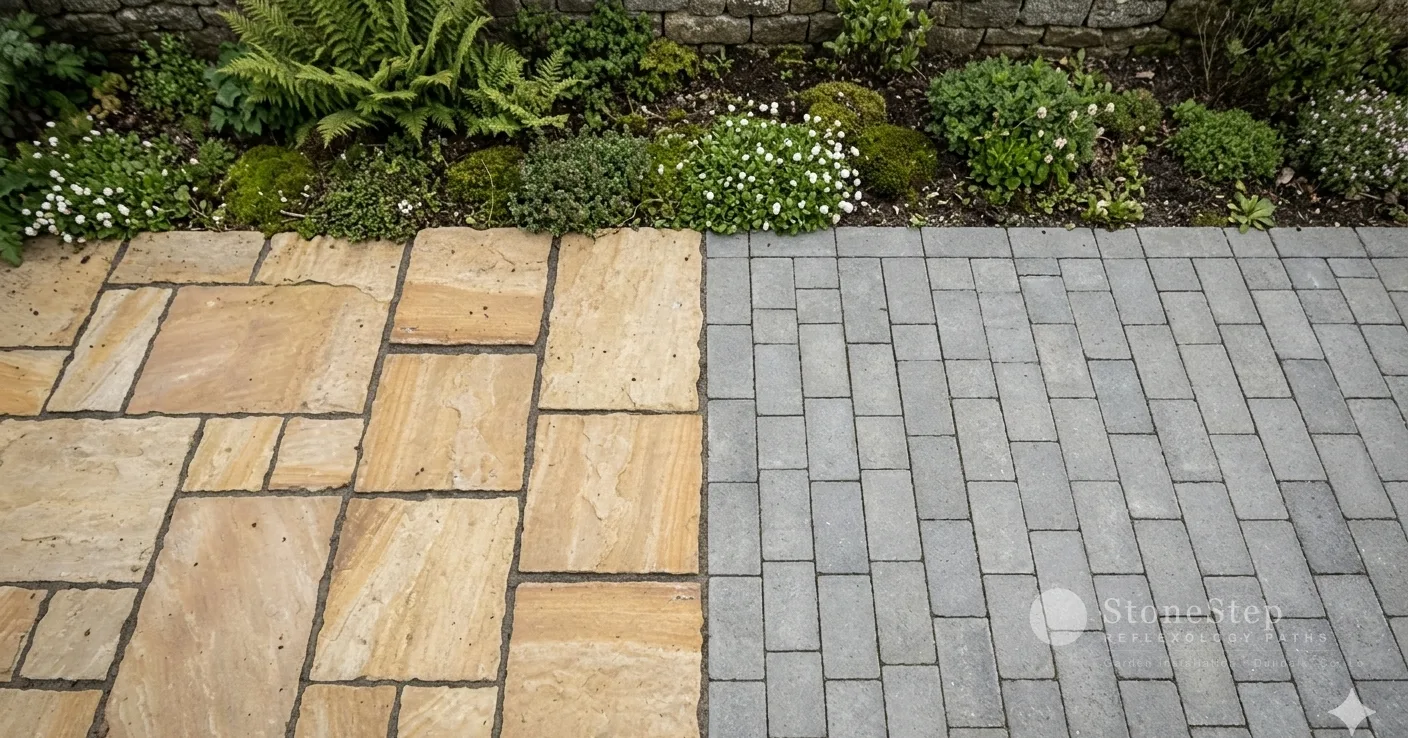
Which Paving Stone Holds Up in Irish Weather
Irish weather is not extreme by global standards. It does not produce the severe winters of Scandinavia or the long baking summers of the Mediterranean. What it produces is something more relentless: persistent moisture, regular freeze-thaw cycles in winter, and high humidity for much of the year.
For paving stone, those conditions are a specific kind of test. They favour density over softness, sealed surfaces over porous ones, and materials that absorb moisture slowly and drain it quickly over those that hold it.
This guide works through how each of the main natural stone types performs in Co. Louth’s climate: what the specific vulnerabilities are, what the advantages are, and what the realistic maintenance commitment looks like over the years you live with the surface.
The Irish Weather Problem for Stone
The primary issue is not cold, rain, or frost individually. It is the combination, repeated across each winter.
Water enters a porous stone surface. Overnight temperatures drop below zero. The water freezes, expands, and exerts pressure on the surface from within. When temperatures rise during the day, the ice thaws, contracts, and leaves behind a slightly larger void than was there before. This cycle, often repeated dozens of times across a northeast Irish winter, is called freeze-thaw action and it is the main driver of surface deterioration in porous outdoor stone.
The defence against it is either high density (less water can enter in the first place) or good sealing (water is prevented from penetrating). Both strategies work. The right choice depends on the stone type.
Granite: The Irish Standard
Granite is the most frost-resistant natural paving stone available. Its igneous structure makes it denser than any of the sedimentary stones and its water absorption rate is effectively zero under normal conditions. Freeze-thaw action has almost nothing to act on.
Granite requires no sealing. It holds its surface indefinitely. Silver granite and yellow granite are both used widely across Co. Louth and in Irish hard-landscaping generally; the cool tone of silver granite suits contemporary garden schemes and the warmer yellow granite sits well with traditional properties.
The single practical limitation of granite is cost. It is the most expensive of the mainstream natural paving stones, both in materials and, due to its hardness, in cutting and installation. For a patio or garden path where a very long maintenance-free life is the priority and budget allows, granite is the right choice. For most residential Co. Louth garden projects, the argument for granite is strongest for high-traffic areas, entrance approaches, and surfaces that are difficult to access for maintenance.
Limestone: Dense and Low Maintenance
Limestone is denser than sandstone and significantly more frost-resistant. Its lower porosity means water penetration is slower and the effects of freeze-thaw cycles are less pronounced. Limestone sealed on installation and resealed every four to five years performs very well through Co. Louth winters.
The risk specific to limestone is acid erosion rather than frost damage. Limestone is a calcium-based stone that reacts with acidic substances. This means avoiding acidic cleaning products, prompt removal of leaf tannin staining (particularly from oak and lime trees, which leave strongly acidic deposits), and keeping the surface clean of organic debris that breaks down over time. This is a manageable maintenance requirement, not a structural concern.
Blue-grey limestone has a particular affinity with Irish domestic architecture and with the landscape of northeast Leinster. Liscannor limestone, sourced from Co. Clare, performs well in Irish conditions and carries the additional value of being native stone in every sense.
Sandstone: Good Performance with Active Maintenance
Sandstone is the most widely used natural stone for garden paths and patios in Co. Louth, and its weather performance is frequently misrepresented in both directions.
Unsealed sandstone is genuinely vulnerable to frost damage in northeast Ireland. Its relatively high porosity means water absorption is significant, and surface spalling, where thin layers of the stone surface flake away over successive freeze-thaw cycles, can develop on unsealed sandstone within a few years of installation.
Sealed sandstone is a different proposition. A penetrating silicone or water-repellent sealer, applied on installation and refreshed every three to four years, reduces water absorption dramatically and removes the main mechanism for frost damage. Sealed sandstone paving in Co. Louth, properly installed and maintained, can last thirty years or more without structural deterioration.
The sealing requirement is the key maintenance commitment. If you want natural stone that performs well in Irish weather with minimal intervention, limestone or granite are lower-maintenance choices. If you are willing to carry out the sealing schedule, sandstone provides the warmth of tone, the textured grip, and the affordability that make it the most popular choice in Co. Louth despite its maintenance requirements.
Slate: Naturally Resistant, Quality-Dependent
Slate is metamorphic stone: denser and harder than either sandstone or limestone. Its naturally low porosity means it absorbs very little moisture and performs well in freeze-thaw conditions without sealing. It drains well from a riven surface.
Two significant caveats apply in an Irish context.
First, slate quality varies enormously depending on source. Welsh or Spanish slate, properly calibrated to a consistent thickness, is a high-quality, durable material. Chinese slate, which is widely available and cheap, has a high lime and salt content that causes white surface efflorescence, blooming, and surface breakdown over time. In Co. Louth’s moist climate, this process is accelerated. If specifying slate for outdoor use, the country of origin and quality certification matter.
Second, grip. A riven slate finish provides good traction underfoot in wet conditions and is appropriate for exterior use. A polished or honed slate finish is not appropriate for exterior paths or patios in Ireland: it becomes slippery when wet in a way that creates genuine safety risks. We recommend only riven or naturally split slate finishes for exterior installation.
The Porcelain Comparison
For completeness, porcelain deserves a mention as the standard against which natural stone performance in Irish weather is often measured. Porcelain’s near-zero water absorption rate makes it essentially immune to frost damage and it requires no sealing. These are genuine advantages and they explain its growing popularity in Irish gardens.
The limitations of porcelain are covered in our natural stone versus porcelain guide. For this specific question, how stone performs in Irish weather, porcelain performs excellently. The choice between porcelain and natural stone is ultimately about what you want the surface to be, not about weather performance alone.
A Practical Summary for Co. Louth
The stone that performs best in Co. Louth’s climate with the lowest maintenance commitment is granite, but it is also the most expensive.
The stone that performs well with moderate maintenance and is the most widely used is sealed sandstone. The sealing schedule is the price of the warmth of tone and the affordability.
Limestone sits between the two: denser and lower maintenance than sandstone, less expensive than granite, and with a particular suitability to the Irish landscape that is worth considering.
Slate performs well when the quality is right and the finish is appropriate. It is not a universal choice but suits specific garden contexts and property types where its character adds something.
For more on stone selection, installation, and what each material costs in Co. Louth, see our stone type comparison guide and our garden paving service.
Frequently Asked Questions
How often does sandstone really need sealing in Co. Louth? Every three to four years is the standard recommendation for sandstone paving in northeast Ireland. In very shaded positions with persistent moisture and poor air circulation, every two to three years is more appropriate. A simple test: pour water on the surface. If it absorbs immediately rather than beading, resealing is due.
Is frost damage covered under installer guarantees? Frost damage to an unsealed stone surface is generally considered a maintenance issue rather than an installation defect. Frost damage to a properly sealed stone surface on a sound sub-base, in our experience, does not occur in normal Co. Louth winter conditions. If you experience surface deterioration on a recently installed patio, the most likely cause is either inadequate sealing at installation or sub-base drainage issues rather than the stone itself.
Can I seal the stone myself or does it need a professional? A quality penetrating sealer applied with a brush or roller to a clean, dry surface is a straightforward DIY task for most homeowners. The critical requirements are: the surface must be completely dry before application; the stone must be clean of any algae, moss, or existing sealer residue; and the product must be appropriate for the specific stone type. We provide guidance on this at handover.
Does granite really never need sealing in Ireland? Granite’s water absorption rate is so low in standard outdoor applications that sealing provides no meaningful benefit. Granite can stain from organic material in prolonged contact, as can any stone, but this is a surface cleaning issue rather than a penetration concern. For most Co. Louth residential applications, granite does not require sealing.
Have a question about your garden?